

‘Now is the time to make consultation and accommodation the absolute bare minimum,’ states Anishinabek Nation Grand Council Chief
By Sam Laskaris
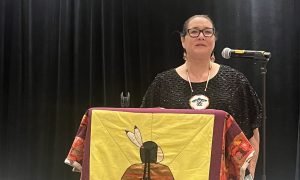
TORONTO – Anishinabek Nation Grand Council Chief Linda Debassige understands how hectic lives can be.
And that’s why she felt it was important to get key players, including Chiefs, First Nations representatives, and industry partners, all in the same room at the same time for some critical discussions.
The result was the Anishinabek Nation Energy Engagement Forum, held May 26-27 in Toronto.
During her opening-day address, Debassige said various First Nations leaders are often inundated with requests about energy initiatives.
“Our Chiefs are incredibly busy in their communities,” she said. “And our community leadership is pulled in many directions. They work daily to address the challenges, issues, and opportunities that they sometimes just land on your desk out of nowhere.”
Grand Council Chief Debassige felt some face-to-face meetings with industry partners, who also delivered presentations on their organizations at the forum, would prove to be productive.
When mapping out themes for the engagement forum, Grand Council Chief Debassige said a goal was to shift the conversation from consultation to engagement and relationship-building because that didn’t really happen.
“It’s always like that for our First Nations,” she said. “Canada makes an announcement, flows all the way through, provinces pick it up. And then, it’s like, ‘We’re going to go do this, and, okay, First Nations, we’ll give you some money to tinker around over here.’ We never really took the time to build these relationships for the benefits of our community.”
Anishinabek Nation supports 39 First Nations throughout Ontario, whose territorial lands cover about one-third of the province.
“And really, what that means is that any type of electrical building, of electrification, is going to come into our territories,” Debassige said.
Anishinabek Nation has passed a resolution to create an energy plan with its First Nations, to help lift them, to help bring opportunities, to help the Nations understand that no matter where they find themselves, what potential opportunities are, as well as challenges and risks
“No matter where we find ourselves, we have to engage as Nations,” Grand Council Chief Debassige said. “At times, we can’t wait for them to come to us. We have to go bang on their doors and say, ‘Hey, we’re here. Don’t forget about us.’”
She said that’s because a relationship needs to start, whether that is a bad one or a good one.
“If there is a will to make sure that industry, governments, proponents really do want to respect the rights of our First Nations within the Anishinabek Nation, then they will come,” she said. And they ought to come. I can’t speak more strongly about the strength and unity across one third of this province that we have together, and the importance of working together so that we can all see our Nations be successful.”
Grand Council Chief Debassige also said there is a need to have more direct relationships.
“How do we help our Nations from just being project participants to partners in planning, to be at that table, to create that space–that willing space–where our Nation’s voices can be heard, can be trusted, and their advice strongly taken?” she said. “How do we connect our Anishinabek Nation communities to Ontario’s energy ecosystem?”
She also said dramatic changes are coming.
“In Canada, energy demand with consumption is expected to surge by up to 44 per cent by 2050,” Grand Council Chief Debassige said. “The largest will be in Ontario. That means our Nations will be impacted some way, some how.”
Grand Council Chief Debassige also said organizers wanted to create this forum so community energy champions can take information back to their respective Chiefs and Councils that were unable to attend.
“When we don’t know (details about projects), we are automatically going to go into protection mode,” she said. “And we are going to defend the little that we have left. And that will result in roadblocks. That will result in our grassroots citizens standing up to protect things. And that will happen if our Nations are not talked to. So, from never being consulted, to barely consulted, and to be begrudgingly accommodated, to today.”
Grand Council Chief Debassige also talked about the fact that Canada has recently released its electrification strategy to double transmission and generation and interconnect provinces with new smart transmission rules. That will require co-operation from Premiers, which, early on, appears challenging.
“But perhaps there are opportunities for our Nations to build relationships with other Nations,” Grand Council Chief Debassige said, adding First Nations in Ontario might join forces with First Nations in Manitoba or Quebec to work together on joint ventures.
This reiterates her belief that it is time for Anishinabek Nation to think beyond its own borders.
“The Anishinabek Nation alone has over 70,000 citizens and when we can inspire hope and opportunity, that starts taking over back this country,” she said.
She also offered other thoughts she deemed crucial.
“We cannot leave any of our Nations behind,” she said. “Now is not the time to backtrack on the progress the sector has made over the last 15 years, just because it is expedient or as a knee-jerk reaction to a changing world. Now is the time to make consultation and accommodation the absolute bare minimum…Our lands will host tomorrow’s energy projects. Our lands hold the minerals that will power them. And our young people will provide the skilled workforce that builds it.”