

Anishinabek Educational Institute reaches major milestone in Indigenous institute accreditation process
By Abigail Yzereef
NIPISSING FIRST NATION—The Anishinabek Educational Institute (AEI) currently delivers accredited programs through valued partnerships with institutions such as Canadore College, St. Clair College of Applied Arts and Technology, and Loyalist College. While these partnerships remain an important part of AEI’s educational offerings, the Institute has long worked toward becoming an accredited Indigenous institute capable of delivering its own accredited programs. This designation is granted through a rigorous organizational review led by the Indigenous Advanced Education & Skills Council (IAESC), an Indigenous-controlled, not-for-profit, quality assurance organization that supports Indigenous institutes in Ontario through culturally grounded standards that are rooted in Indigenous knowledge, traditions, worldviews, and academic excellence.
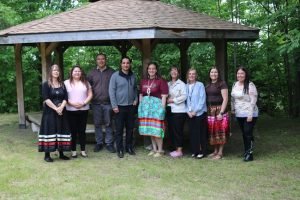
A significant milestone in this process recently took place on June 23, when AEI welcomed the IAESC External Review Panel to its Nipissing Campus for the site visit component of the Organization Review process. Prior to the visit, panel members conducted a thorough review of AEI’s application and supporting documentation. During the site visit, they met with staff, reviewed AEI’s operations and governance, toured the campus, and engaged directly with students to gain a comprehensive understanding of the Institute and its readiness to deliver accredited programs.
The External Review Panel included Brock Pitawanakwat, Associate Professor of Indigenous Studies at York University and a citizen of Whitefish River First Nation, and Brent Debassige, Associate Professor in the School of Liberal Arts at Laurentian University and a citizen of M’Chigeeng First Nation. Supporting the review process were IAESC representatives Tammy McNabb, Senior Quality Assurance Advisor, and Sue Eckenswiller, Director of Regulatory and Strategic Partnerships.
The day began in a good way with an opening prayer from AEI’s On-Campus Gookmis (Grandmother), Virginia Goulais. Sharing her experiences supporting learners, Gookmis Goulais spoke about the importance of culturally rooted education, and the safe, supportive environment AEI provides for students. Following the prayer, Interim Quality Assurance Manager Melanie Miller and Social Media & Communications Coordinator Abigail Yzereef shared the Ngo Dwe Waangizid Anishinaabe preamble, and the AEI’s drum group welcomed the panel with a song.
AEI then opened its presentation with a video highlighting a key AEI philosophy, Maamwi Gikendaasomin — We Learn Together. Through interviews with students, alumni, staff, instructors, and Grandmothers, the video illustrated how community, culture, and relationship-building contribute to student success.
Throughout the day, AEI staff demonstrated how the Institute’s governance, strategic direction, academic programming, student supports, enrolment and recruitment, communications, quality assurance processes, and organizational operations work together to support learner success and advance AEI’s vision as an accredited Indigenous Institute. As part of this overview, AEI’s Director of Education Mindy Taylor and Anishinabek Nation Executive Director Brendan Huston highlighted AEI’s history and distinct governance structure, which is rooted in 1993 and 1994 Chiefs-in-Assembly resolutions that directed the development and formal establishment of the AEI. Together, the presentations illustrated how AEI’s mission of providing education “by and for Anishinabek People; at our pleasure, at our pace, and by our own standards” is reflected across all areas of the organization.
In a separate discussion with AEI’s management team, the panel explored topics including accessibility, student support, organizational capacity, community partnerships, and future growth. Campus Manager Lacey Smith opened the conversation by outlining several opportunities and challenges AEI is currently addressing, including space limitations, the growing demand for Knowledge Keepers and culturally grounded supports, and the implementation of a fully integrated Student Information System and Learning Management System. Smith explained that these initiatives are intended to improve operational efficiency and enhance the student experience as AEI continues to grow.
Campus Manager Jennifer Fletcher highlighted AEI’s adaptability and commitment to meeting students where they are, noting that when the COVID-19 pandemic disrupted in-person learning, “we were able to flip our delivery to online in a week, and we are still working with our students to find what is most accessible to them. We want it to be as accessible as possible to all who want to learn.” Fletcher also spoke about AEI’s strong relationships with community placement partners and the Institute’s commitment to creating inclusive learning opportunities for students.
The discussion also highlighted the advantages of AEI’s connection to the Anishinabek Nation. Miller described how AEI collaborates with other Anishinabek Nation departments to strengthen student supports, including ongoing work with the Health Department to better serve learners with neurodivergent needs.
When asked about the Institute’s capacity to support future growth, Taylor acknowledged that AEI continues to assess and strengthen its organizational structure while developing leadership capacity across the Institution. Taylor emphasized that accreditation is an important milestone in AEI’s ongoing journey to strengthen Indigenous-controlled post-secondary education and fulfil the vision established by the Chiefs-in-Assembly, while continuing to enhance meaningful partnerships that support the Institute, its learners, and the communities it serves.
A key component of the site visit was an opportunity for the External Review Panel to meet directly with current students. Emma Beck, a first-year student in AEI’s Practical Nursing program, and Helen McCart, a second-year student in AEI’s Social Service Worker: Indigenous Knowledge program, participated in a question-and-answer session with the panel, sharing their experiences with student support, accessibility services, and culturally grounded learning.
When asked about the supports available to students, McCart emphasized the personalized assistance she has received at AEI.
“We’re very supported. I’ve never had to ask for more,” she said, noting that staff helped her secure a placement at the Ojibway Women’s Lodge when she was having difficulty finding one on her own.
Beck spoke about the institute’s accessibility services, explaining that when she disclosed challenges with reading comprehension, AEI helped her access accommodations including digital textbooks and Kurzweil 3000 software.
Both students described the cultural impact of their studies. McCart reflected on how attending AEI strengthened her connection to her culture and family.
“I was disconnected from my culture before,” she explained. “I don’t think I fully understood until I got here. It was eye-opening.”
Beck added that the teachings embedded throughout AEI’s programs extend beyond academics.
“Learning about the Seven Grandfather Teachings is learning for life,” she said, while McCart emphasized the broader impact of that learning. “We’re becoming advocates in our community.”
Their perspectives offered the panel valuable insight into the ways AEI’s programs, services, and learning environment contribute to student success.
The panel also participated in a guided tour of AEI’s Nipissing Campus, visiting learning spaces including classrooms, the Practical Nursing Lab, Elder’s Hall, the Sensory Lounge, student gathering spaces, and administrative areas. The tour allowed panel members to see firsthand the facilities, resources, and culturally supportive environment available to students.
The site visit marks an important milestone in AEI’s accreditation journey. The External Review Panel will now finalize its report for consideration by the Indigenous Institutes Quality Assurance Board (IIQAB). Following its review, IIQAB will make the final decision regarding AEI’s accreditation.
AEI looks forward to continuing this journey and advancing its commitment to providing high-quality, Indigenous-led post-secondary education for Anishinabek learners and communities.