

Frank Polson painted over the dark times
By Maurice Switzer
ANISHINABEK NATION TERRITORY — Frank Polson’s vibrant acrylic paintings outshine the darkness that at times challenged the artist’s life.
When he passed into the Spirit World just hours after his 74th birthday, the Algonquin craftsman left a legacy of some 4,000 canvases that bore his signature, in addition to soapstone carvings and even the odd totem pole.
Polson never sugar-coated a professional career that began when he was serving a 60-month federal prison sentence for a life-threatening assault.
“I became an artist when I was 42 and in jail,” he freely revealed to me when I first interviewed him for the Anishinabek News. He was inspired by the talent of a fellow First Nation inmate, Steve Toulouse, but jailhouse art materials were in short supply.
“Sometimes, we used old blue jeans for canvas, and house paint for the art,” he smiled, recalling that his work was greatly influenced when he came across a book featuring the iconic Woodlands art style of Norval Morrisseau.
Polson’s paintings invariably feature the familiar black “power lines” to connect the beings and creatures he portrayed to illustrate the interconnectivity of all living things.
As a boy, he had first made sketches of the beaver and moose he saw on his father’s trap line, and these images breathed new life on the canvases he began creating in prison.
When I first met him in Ottawa some 30 years ago, Polson was living the typical itinerant life of many Indigenous artists, peddling paintings literally from the trunk of his car, making regular stops at band offices, and the workplaces of First Nation political organizations like the Assembly of First Nations and the then-called Union of Ontario Indians (now Anishinabek Nation).
He was experimenting by painting on pieces of birch bark that gave his works a three-dimensional effect. I asked if he could make me one that featured the image of a turtle. A few weeks later, he showed up at my office door with the piece I had commissioned, and for which I was glad to pay him $300.
During his “starving artist” phase, Polson credited his painting with helping him overcome depression and addiction; he said his art was his medicine. At one point, he subsidized sparse sales by driving cross-border cigarette “deliveries.” He was one of several First Nation artists who received a great deal of support and encouragement from the late George Maroosis, longtime North Bay city councillor and art store owner.
Polson’s prices increased by a full decimal point as his door-to-door marketing made him a familiar figure on the Indigenous art scene, and his work attracted the attention of galleries in Ontario and Quebec.
In 2018, Frank accepted a commission from the Royal Canadian Mint, which released a series of $3 silver commemorative coins bearing his sketches depicting the 13 Grandmother Moons of the Anishinabek calendar. All 4,000 subscription sets were quickly sold out.
He was thriving personally and professionally, thanks largely to finding a partner who shared his vision to use art to help people understand First Nations culture. Former schoolteacher Danielle Desjardins injected business and marketing smarts into Polson’s art practice.
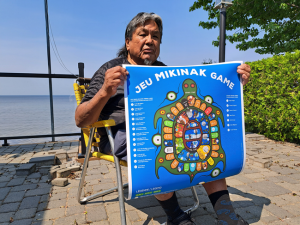
They produced colouring books that were distributed to schools near Polson’s home base of Winneway, Quebec, in Long Point First Nation. Next came a game that featured a Polson painting on canvas of a turtle as the board in a game that featured Medicine Wheel teachings.
As much as Polson enjoyed selling paintings as far afield as Europe, he was most appreciative of recognition closer to home.
In June 2024, the community of Winneway came out to celebrate the official opening of Skydreamer Studio, an elegant two-storey wooden building for which Polson’s First Nation was instrumental in securing funding.
As a longtime supporter of his journey, I was completely comfortable teasing Polson about his newfound successes, like the time he splurged on a cabin cruiser. But I never forgot his lows.
On learning of Polson’s passing, his community issued the following statement:
“Long Point First Nation extends its heartfelt condolences to all family members, extended family, friends, and acquaintances on the passing of Frank Polson, a respected artist, community member, and proud Anicinabe whose work touched countless lives both within our nation and far beyond. LPFN Council and all the staff would like to extend their sincerest condolences to Council member, Mr. Sky Polson, son of the late Frank Polson.”
———
Maurice Switzer, Bnesi, is a citizen of the Michi Saagig of Alderville First Nation. He was a friend of Frank Polson and will continue to enjoy his art.