

Netmizaaggamig Nishnaabeg Elder Tony DePerry shares his lifelong learning journey
By Rick Garrick
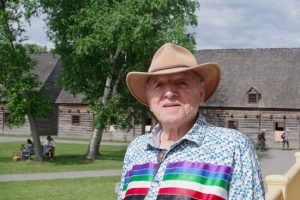
THUNDER BAY — Netmizaaggamig Nishnaabeg Elder Tony DePerry recently highlighted his path to doing Sunrise Ceremonies and other traditional activities after a meeting on June 24 at Fort William Historical Park in Thunder Bay, Ontario.
“I do everything in Ojibwe (Anishinaabemowin),” Elder DePerry says about Sunrise Ceremonies. “I speak in Ojibwe and then I’ll translate as much as I could after for people to understand what’s happening and what is going on.”
Elder DePerry says he began learning from his grandfather about the traditional teachings when he was young.
“I didn’t learn to speak English until I was nine years old,” he says. “I lived out on the land; my grandfather had 72 square miles of trapline. I didn’t speak English… he spoke Ojibwe and I spoke Ojibwe, so everything he did was through our culture.”
Elder DePerry says the trapline was located east of Marathon, Ontario.
“It’s mountainous, there’s rivers, there’s lakes, it’s beautiful,” Elder DePerry says. “We used snowshoes, back then, in my time, there were no [snowmobiles].”
Elder DePerry says he learned the teachings from his grandfather and five other Elders.
“They all said the same thing, but in a different way,” Elder DePerry says. “[My grandfather] told me a lot of things in Ojibwe. I was out on the trapline, I did this and that, I skinned my own fur, and I had my own trapline.”
Elder DePerry says he has teachings from approximately 17 generations.
“I tell legends and I tell stories,” Elder DePerry says. “I translate the whole thing from Ojibwe to English so people can understand what I’m talking about.”
Later, on June 24 during a phone interview, Elder DePerry said his grandfather and grandmother always taught him to pay attention to what he was doing.
“Pay attention to what you see, pay attention to what you feel,” Elder DePerry says. “As a result of all that, I became a herbologist because I understood exactly what the plants were, what the flowers were, what the grass was.”
Elder DePerry says First Nations people always had a good sense of humour in the past.
“They laughed at everything, they laughed at each other, they laughed at how things worked in life,” Elder DePerry says. “As a result, I learned that a photographic memory was the best thing you can have.”
Elder DePerry says First Nations people learned by sight, sound, and other methods in the past.
“We didn’t have the instructions on how to make a birch bark canoe but we made it; snowshoes, we made it, when we tan a hide, we did it,” Elder DePerry says. “There’s all kinds of things that we did. The female had a big responsibility, they did all kinds of things, and the man was to gather things for the mothers and the grandmothers and for the girls.”
Elder DePerry says the Indian Residential School System created a lot of pain and sorrow among the First Nations people.
“We should learn about humour, we should learn about justice,” Elder DePerry says. “We should learn about one another in the good way of life.”