

Dilico Anishinabek Family Care celebrates 40 years of community knowledge and care
By Rick Garrick
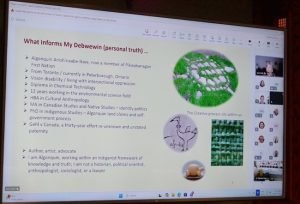
FORT WILLIAM FIRST NATION— Dilico Anishinabek Family Care’s 40th Anniversary Annual General Meeting (AGM) featured a keynote presentation by Lynn Gehl on Indigenous Knowledge versus Western Knowledge on July 22 at Dilico’s Main Office in Fort William First Nation.
The 40th Anniversary Gala Night was postponed until September due to the housing of forest fire evacuees at the original location, the Superior Inn Hotel and Conference Centre in Thunder Bay.
“This year’s theme is Gikandowsiwin, our knowing, our knowledge, our ways of doing,” says Natalie Paavola, CEO at Dilico Anishinabek Family Care. “For the communities that created Dilico [Anishinabek Family Care] over 40 years ago, we’re celebrating their knowledge, their community ways of doing and being, and Dilico [Anishinabek Family Care] is an extension of that. We’re their agency, and we provide services the way they need us to provide services.”
Paavola says Gehl provided examples during her keynote presentation of Indigenous knowledge models that are practiced within the Indigenous community.
“That is what I wanted to share here today — sometimes there are challenges when we’re trying to explain that we have our own ways of knowing, we have our own ways of doing, and if they are supported and allowed, it makes better outcomes and better progress for the communities and for the services that we provide,” Paavola says.
Gehl says she was excited to speak about Indigenous knowledge during the AGM.
“It’s such an important topic, how we know, what we know, and how we move forward with our knowledge is something that I’ve spent a lot of time thinking about,” Gehl says. “There is a lot of discussion about the need to return to Indigenous knowledge — some people are unable to grasp what Indigenous knowledge is because it sits outside the prevailing paradigm that we’ve all been socialized into. Of course, this doesn’t apply to Indigenous people but more the majority population; the majority of Canadians have been socialized into a different knowledge system and shrunk the space of Indigenous knowledge.”
During the AGM, Gehl also highlighted some of the models she created to convey the importance of Indigenous knowledge.
“As a recap, I want to talk about what are Indigenous ways of knowing and being, where is Indigenous knowledge and who has it and how do we get some more, and how do we continue to make more Indigenous knowledge,” Gehl says. “Indigenous knowledge is in the land and the other beings, it predates human arrival, yet humans are doing some really destructive things. It’s important to say that Indigenous knowledge is local, and that it emerges through a relationship between the land and the greater cosmos.”
Gehl adds that Indigenous knowledge in Thunder Bay, for example, is going to be different than Indigenous knowledge in Toronto.
“It’s in our dreams and our visions — dreams and visions can really guide us and shape us forward,” Gehl says. “It’s in our language and symbolic literacy form — our language is more verb based, a really important difference. I really want to stress that we do have a symbolic literacy form, it’s in our communities and all members of our communities, not just the Elders, it’s in the traditional people, children, community experts, … intellectuals and today, we have academics.”
Gehl says an example of ancient symbolic literacy form is wampum diplomacy.
“What is really important in these [wampum] belts is the knowledge inherent in them is just as important as the material item,” Gehl says. “A lot of people think that wampum diplomacy holds an essential truth — we need to appreciate that wampum did change and shift over time, we used different kinds of shell, for example, and we used different kinds of materials to weave.”
Gehl says the original three wampum belts of the ones she had on display codified the relationship between Indigenous nations and British Canada as being nation-to-nation and one of equals.
“These [original] belts were exchanged in 1764 at the Treaty of Niagara, so this is a wonderful example of our symbolic literacy system, which indeed is valid and legitimate,” Gehl says.