

First Nation Chartered Professional Accountant tells conference attendees money should be used with intention
By Sam Laskaris
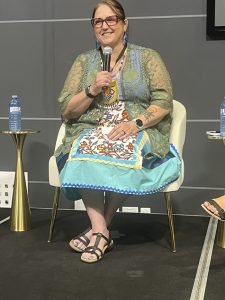
TORONTO – With more than three decades of experience under her belt, Helen Bobiwash, a Chartered Professional Accountant from Thessalon First Nation, is considered a leader in her industry.
Bobiwash has become well respected in her field as she combines her financial savvy with a solid understanding of Indigenous governance and culture, enabling her to lead organizations into making impactful decisions.
Bobiwash shared some of her lived experiences at the Rezolution Summit, which was held August 11-12 at the TMX Market Centre in downtown Toronto.
She was a panellist on an opening-day session at the conference titled The Architecture of Protection: Designing for Wealth, Growth, and Resilience.
“I’ve been an accountant for 35 years,” said Bobiwash, who lives in Sudbury. “And it’s really hard for me to say that because I just feel like I graduated college.”
Bobiwash’s current responsibilities include serving as a Director with the First Nations Financial Management Board as well as the Building Ontario Fund.
Bobiwash said she grew up in an urban centre without much money and was isolated from family.
“We didn’t have the circle of community around us that you see in First Nations,” she said. “And I’ve since lived on a First Nation and have experienced that community. But being in an urban centre, we’re much more isolated from our family. So, we didn’t have the community to take care of us and to help us, even though we had no money. The community always manages to share their wealth with you when you’re in the First Nations and smaller communities. But we just didn’t experience that.”
Bobiwash said the reason she chose accounting as a career stemmed from the fact she was good at math.
“I wanted to find a job that gave me some financial security because I really saw that I couldn’t participate in life without any money,” she said. “And money isn’t the be all and end all of everything. But it’s a currency that we have, and we need to rely on in contemporary life.”
Bobiwash also said that while using money with an Indigenous lens, it should be utilized with intention.
“When you use money with intention, you can use it towards whatever goals you have set for yourself,” she said. “But to have that intention, you need to understand how are you using it and how do you want to use it in the future.”
Bobiwash also said bookkeeping systems are vital. For those who handle their finances, they get a sense of how money is being spent, either by themselves or others.
“And at some point, you’re going to be looking for some financing,” she said. “If you want to grow the business, at some point you’re going to need financing. You need to show that you have used your money with intention to grow the business and you still continue to plan to do that and continue to after you get the financing. So, that bookkeeping system will help you.”
Bobiwash said not everybody needs to be in charge of their own bookkeeping.
“You don’t have to do it all yourself,” she said. “Hire somebody. Hire somebody who has that gift and get them to take care of you.”
During her conference session, Bobiwash also discussed her time as a Fiscal Negotiator for the Anishinabek Education System, which advocates for investment in First Nations education for 23 First Nations. Her work led to a 2017 agreement which restored education jurisdiction to the First Nations.
“I’m really proud that I was a part of that,” Bobiwash said. “They were negotiating for 20 years to regain jurisdiction over their education. And I came in the 19th year. So, they did a lot of work in all the negotiating priority setting before I came on.”
But she was thrilled to have a say in the direction of First Nations education.
“That, to me, was really exciting because our people have grown up in education systems that have caused damage and that caused harm,” she said. “In the Anishinabek Education System, one of the aspirations is that our children will not be harmed in our schools. And that still hits me in the heart when I think about that.”
Bobiwash is also pleased she can assist First Nations with financial literacy needs.
“For me, it comes down to helping our future generations to understand what they need for their own future,” she said.