

Indigenous Tourism Ontario drone shows take off in popularity
By Sam Laskaris
AUNDECK OMNI KANING FIRST NATION – Kevin Eshkawkogan is ecstatic that an Indigenous Tourism Ontario (ITO) initiative is soaring, literally.
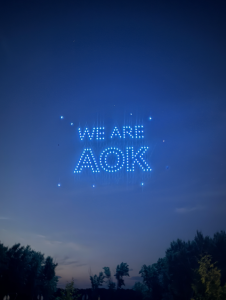
ITO staged its first drone show event in Little Current, the largest community on Manitoulin Island, back in 2021.
“The demand for the drone shows and how we do them, telling First Nation stories with these vehicles of drones, has become incredibly popular,” said Eshkawkogan, who is ITO’s president and CEO.
Eshkawkogan, a citizen of M’Chigeeng First Nation, has spearheaded ITO’s drone show program and taken it on the road across Ontario. He’s keen to expand programming into other provinces as well.
This year’s schedule included a pair of shows in late July in Aundeck Omni Kaning First Nation, at the Four Directions Event Complex, a facility which is also ITO’s headquarters.
The next show within the Anishinabek Nation territory is scheduled for September 5 in M’Chigeeng First Nation.
“Right now, we’ve got some prepackaged shows that people could purchase,” Eshkawkogan said. “And we fly them. It’s all turnkey. You tell us the date, the location, the event, and away we go.”
Up to 200 drones are utilized in each performance.
“Some of them are very appropriate to regions,” Eshkawkogan said of the various drone shows. “For example, this past week, we flew the History of Treaty 9 in Moose Factory. And they actually had the actual treaty at their event gathering of our people. And we incorporate, we customize that one a little bit. We incorporated local people doing goose calls, moose calls, and narrating the show.”
Besides The History of Treaty 9, other premade drone shows that ITO runs are titled 150 Years of the Indian Act, Seven Grandfather Teachings, and the Haudenosaunee Creation Story.
Eshkawkogan shared some of the positive feedback he received following the Aundeck Omni Kaning First Nation shows.
“I was told this is an amazing tool, not just for economic reconciliation or reconciliation in general,” he said. “But it’s a great tool for cultural revitalization. It’s not the only tool. But it’s a part of a larger spectrum of tools that can be used to engage the youth and help us tell our stories and share some of that history, the culture, traditions, and so on.”
Eshkawkogan said the 150 Years of the Indian Act show has been flown in both Anishinabek and Haudenosaunee territories.
“We’re going to be taking that out to out to B.C. (British Columbia) in September,” he said. “And we’ve been to a lot of different places in Quebec with that show.”
Eshkawkogan is amazed by how popular the drone shows have become since the initial show in Little Current.
“At that point in time, we were still under lockdown in Ontario [because of the COVID-19 pandemic],” he said. “We did a virtual summer solstice Indigenous festival in collaboration with the national one. We basically broadcasted all our programming on a giant screen. And we did a drive-in drone show.”
Eshkawkogan explained that shows using more than 50 drones require two pilots.
“But then we bring in [a] grounds crew,” he added. “We usually hire youth. We’re not restricting it to youth, but it is for anybody who is interested in this. We usually hire four [members of the] grounds crew from the local community to not just, like, move stuff. We want them actually learning about the drones and the processes, and seeing who’s got an aptitude and who’s interested in this as a potential career for themselves.”
Eshkawkogan said grounds crew members had zero training before being hired.
“We bring them in, and we start them from scratch,” he said.
Some crew members have travelled to all 10 Ontario shows thus far this year. Three individuals, however, worked their first shows at the Aundeck Omni Kaning First Nation events.
“They’re going to let us know if they’re interested,” Eshkawkogan said. “And if they are, then we bring them back for other shows. And we kind of help them mentor other new people that come along.”
Bookings for 2027 shows have already commenced. Eshkawkogan said ITO officials are keen to expand their drone show programming.
He said that in the next 18 months, ITO is planning to have 20 pilots in its stable, working different quadrants of the province to fly in regionalized areas.
ITO is also looking to create more pre-programmed shows. That way people can go to a catalogue and pick a show they want to order.
“We can do some slight modifications like bringing up their community names and stuff like that,” Eshkawkogan said. “We can [also] change the audio.”
His wish is to get the shows into as many communities as possible.
“Our goal is to make these drone shows accessible to Indigenous communities and to really anybody, like northern communities, for example—those that don’t have access to a lot of this technology,” he said. “We make it easy and streamline it in a very cost-efficient manner to them. And it aligns with things that they want to learn.”