

Connecting youth to traditional teachings on medicines, the land, and harvesting
By Rick Garrick
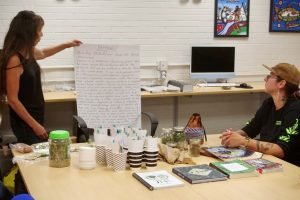
THUNDER BAY — Fort William’s Whillow Bannon-Lamb enjoyed participating in the Food Action Network of Northwestern Ontario’s Guided Plant Harvesting Walk at Lakehead University on Aug. 21 in Thunder Bay. The land-based workshop, which included a Medicine Walk, cultural teachings, tea-making, and traditional recipe guides, was presented by Aroland’s Shelby Gagnon, Indigenous food sovereignty coordinator at the Food Action Network of Northwestern Ontario, Couchiching’s Helen Hill, a homeopathic practitioner who has studied traditional medicines, and Rachel Johnson, a master’s student at Lakehead University with settler and Woodland Cree ancestry from Treaty #6 territory.
“It was a good experience, really peaceful,” Bannon-Lamb says. “I think it was really useful to learn about the plants — it’s not something that you come across commonly, and it is very useful to know about the medicinal benefits of plants.”
Gagnon says they talked about medicines, the land, and the relationship Indigenous young people have with the land and harvesting, as well as sharing stories during the workshop geared towards participants over the age of 16.
“We were able to go harvest some goldenrod just near the lake here at Lakehead University and talk about the medicinal properties of yarrow and goldenrod,” Gagnon says. “I also brought some of the medicines from my home, some of that being blueberry leaves and roots, mint that I grow in my garden.”
Gagnon adds that she also brought some old man’s beard, rose hip, and cedar to share with the workshop participants.
“There is so much medicines that the land provides and this is just a glimpse of some of them that we could harvest,” Gagnon says. “It was great for them to learn and ask questions, and we finished off with enjoying the tea that we steeped while we were harvesting and eating some manomin with blueberries, cranberries, nuts and maple syrup.”
Hill says the workshop, which was focused on yarrow and goldenrod, went very well.
“I think people are very interested in getting back to their old ways and they’re just looking for something to ignite the fire,” Hill says. “We went out on the land, and it’s actually a beautiful space. Northwestern Ontario is full of medicine, even within the city limits.”
Johnson says they held the workshop because her research showed a gap in access to learning about plant harvesting for urban Indigenous people.
“It went great, definitely a good starting point,” Johnson says. “Shelby and I have been asked to host another event in early September, so the word’s definitely gotten out, and I think that shows people are interested. I’m hoping from this event to write a field report about the event and get some feedback directly from the participants about what went well, maybe what they’d like to see in the future.”
Johnson says they did the Medicine Walk around Lakehead University’s Thunder Bay campus.
“That kind of shows the medicine is all around us,” Johnson says. “It’s just kind of about knowing where to look, how to find it, and for me it’s gaining that confidence to go out and harvest plants.”
Gagnon says she also brought some books on plants and a harvesting poster with the 13 moons to share with the participants during the workshop.
“We talked about what moon we’re in right now, so we’re in the Berry Moon, the blueberries are out,” Gagnon says. “We’re going into Manomin Giizis, which is the Wild Rice Moon, and ricing is going to be starting very soon so we’re very excited about that.”