

James Whetung works to restore wild rice and reconnect generations
By Rick Garrick
CURVE LAKE FIRST NATION — Black Duck Wild Rice’s James Whetung has been working to rehabilitate, protect, and promote wild rice (manomin) for about 44 years in his hereditary territory of Pigeon Lake. Pigeon Lake had been his grandfather’s traditional gathering, hunting, and fishing grounds.
“I started at Curve Lake [First Nation] because our wild rice was becoming extinct, there was hardly any wild rice left here and it had been gone for probably two or three generations, so cultural transmission was not happening on our reserve about how to plant, gather, and process wild rice to turn it into food,” Whetung says, noting that he only knew a little about wild rice when he started working with it. “I knew it was an important part of our culture, but because it was disappearing and so scarce, the cultural transmission from our Elders had been cut off, so I wanted to do something about that.”
Whetung adds that he didn’t want to just have moose, deer, and fish in his diet.
“I wanted to have wild rice, not just because of food but also for spiritual reasons,” Whetung says. “Through the treaties, we were cut off from hunting and gathering year round. That caused a lot of problems with our health because we weren’t used to eating [Western] food, so not having access to our traditional foods is really bad for our health.”
Whetung says he initially learned about wild rice at a food security protest and blockade over wild rice harvesting on the Mississippi River near Ardock in 1982.
“While we were there, they taught us how to gather the rice,” Whetung says. “They taught us how to plant the seeds too, and they taught us those traditional gathering techniques.”
Whetung says he also travelled to other communities to learn more about how to plant, gather, and process wild rice.
“Basically, you’ve got to have seeds, you’ve got to be able to go out and get the seeds off the plants and then you bring the seeds back to shore,” Whetung says, noting that he cures the wild rice for up to seven days in piles that are turned over every day with a pitchfork.
“When we cure it, it adds flavour and it makes a process called crystallization possible. That makes the rice last a lot longer once you roast it.”
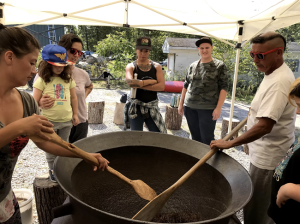
Whetung says they roast the wild rice in a cast iron cauldron.
“When we roast our rice, we’re trying to remove up to maybe 90 per cent of the moisture from the seeds,” Whetung says. “When we do that, that makes the chaff on the seeds become brittle like onion skin, and that’s desirable because the next step is dancing, and when we go to dance on the rice you want the chaff to come off easy or you’ll be dancing it for a long time.”
Whetung says winnowing the wild rice is the last step, which they do by using a sheet or blanket to toss the wild rice into a breeze to blow away the chaff.
“You do that until all the dust and the chaff is blown away,” Whetung says. “And then it’s ready to cook.”
Whetung says he travels to other communities to teach them about wild rice, noting that one of the Anishinabek migration stories says they found wild rice at the far end of Lake Superior.
“That’s where somebody had a dream or a vision and learned how to turn those seeds into food,” Whetung says. “At all [of] our feasts, we’re supposed to have manomin.”
Information about Black Duck Wild Rice is posted online.
Whetung says they are inviting people to attend the 7th Annual Mnoominkewin Gathering at Curve Lake First Nation’s Lime Kiln Park on September 26, noting that more than 750 people participated in 2025, including non-Native people and people from more than 50 First Nations.
“Patti Shaughnessy and I co-founded the Mnoominkewin Gathering in 2020 with the goal of undoing the harms caused by the 1923 Williams Treaty,” Whetung says in an e-mail. “The Mnoominkewin Gathering is a free community event open to everyone who wants to celebrate and learn more about mnoomin.”
Chef Shawn Adler will be serving three free manomin-centred meals featuring traditional foods like moose, pickerel, and Atlantic salmon, and participants will be invited to plant, gather, roast, dance, and winnow manomin.