

Nokiiwin launches underwater drone at Climate Change Awareness Gathering
By Rick Garrick
THUNDER BAY — Nokiiwin Tribal Council and Fort William First Nation held a Climate Change Awareness Gathering featuring the launch of an underwater drone at Chippewa Park’s Sandy Beach on August 24 on Lake Superior.
“We’re just trying to spread awareness about climate change and engage with community on their stories and experiences regarding climate change, and then also just kind of introducing folks into some monitoring methods that a lot of different field people use, Nokiiwin included,” says Heron Ling, Environmental Advisor at Nokiiwin. “So, we have an underwater drone here today, which we will be flying around, which we use to monitor lakes and different water bodies. We also have a microscope so people can take a peek at some water bugs — every year, Nokiiwin samples streams within communities to monitor the water’s health, and those bugs can be indicative of a healthy stream.”
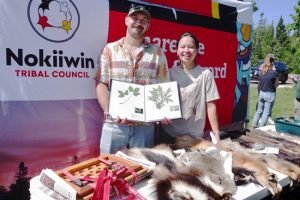
Ling says Nokiiwin’s environmental techs have been developing a plant library with samples of plants in the area that have been collected in a binder over the past couple of months.
“The goal of this plant library is we want Nokiiwin to be able to gift a plant library of not only medicinal local plants, but just any plant that poses significance to the community and the community’s ecosystems, so that youth and other interested people in each community can kind of gain knowledge and have that knowledge inventory at their hands,” Ling says. “They are all native plants that grow within our forests.”
Andrew Base, Natural Resource Advisor at Nokiiwin, says the plant library includes a photo of each plant in its ecosystem as well as a sample of each plant.
“We tried to take a photo in its own ecosystem, so with this one, it’s hard to tell what it is right off the bat. But if you look at its [photo], that’s a bog cranberry,” Base says. “It’s essentially a knowledge library, and we’re going to be making a bunch of these binders for our communities for them to utilize and for them to interpret and then even add onto based off of what they deem as significant.”
Base says the libraries could feature medicine plants, food plants, or plants of cultural significance.
“For example, we have black ash — this is a plant that’s impacted by climate change,” Base says. “With the increase in temperatures over the years, we get more and more emerald ash borer coming up, so we kind of want to raise awareness of: What does this [black ash] look like? How do you look out for them? [and] What are the different conservation methods being used to preserve them?”
Base says they also had fur pelts from different animals from the boreal forest and southern Ontario at the gathering.
“With it, we’ve got an associated language package, so whenever we attend community events, we’ll go in and we’ll play games with the kids and whoever really wants to try it out, and just try to get people familiar with what animals they have on their landscape, learn about their stories and their relations they have with them, and then just talk about language, too,” Base says.
Base adds that they were also doing a climate change survey during the gathering.
“We’re trying to get a better idea of what people have noticed on the landscape on a personal level and how climate change has impacted them, whether it be access to food, access to cultural resources, or anything else in between,” Base says. “So, we’re looking at getting a better idea and kind of mapping out how climate change impacts people.”
Ling says people who are interested in participating in the survey can contact Nokiiwin. Information about Nokiiwin is posted online.