

Book Review: Ishkode: A Story of Fire
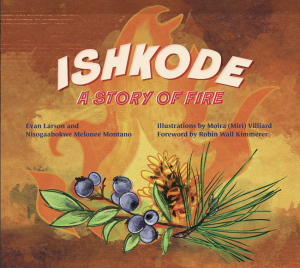
Reviewed by Alex Hebert
As I write this review on Ishkode: A Story of Fire, hundreds of wildfires are burning across Canada. I think about people who are displaced, and the damage the fires has caused to both properties and animal habitats. It’s hard to remember that Ishkode (fire) has a purpose or rejuvenation.
The book is written by two authors. Evan Larson is a professor and enthusiast of trees, fires, and wild places, who has been studying the science of dendrochronology (tree ring dating) and the wisdom of trees since 2001. Nisogaabokwe Melonee Montano is a member of the Red Cliff Band of the Lake Superior Chippewa, and the owner of Ethical Embers LLC, a company that guides individuals, communities, and organizations in incorporating Indigenous knowledge and practices into land management initiatives.
Ishkode: A Story of Fire is a book about the ancient Bapakwanagemagoog (Red Pine Trees) where Aanikoobijigan, a grandmother red pine, guides a young woman, Animikiimiikanikwe, toward healing and renewal through fire. She learns the lessons of the land through dibaajimowinan (stories), and about the power of memory and restoration. This story is about hope, healing, and lessons that people can learn from the land.
Larson mixes the teachings with the science of the tree rings to have Aanikoobijigan and the reader learn about the relationship between people, fire, pines, and the ecosystems in the Great Lakes region.
Robin Wall Kimmerer, who is the author Braiding Sweetgrass: Indigenous Wisdom, Scientific Knowledge and the Teachings of Plans and The Serviceberry (also known as the Saskatoon Berry, which happens to be my mom’s favourite berry!), wrote the foreword to this book.
“We need the stories told by the pines, by the blueberries, by the scientists, and Elders. I am grateful for the gift of this lovely book, which brings their stories to light. May we listen to them closely,” says Wall Kimmerer.
It is a good book to teach the role of fire in the environment. It makes connections between ecological restoration, cultural revival, and stewardship.
The book is beautifully illustrated by Moira (Miri) Villiard from Fond du Lac Ojibwe. I really enjoyed the art since it depicts the spirits in every living thing.
Ishkode: A Story of Fire has an Ojibwe Pronunciations Guide and glossary of Anishinaabemowin. It seems to me that these are Minnesotan dialect, and many of the words seemed very similar to the Manitoulin dialect. Most words were spelled similar. A lot of the words were new to me.
At the back of the book, the creators acknowledge that “the writing of this book was made possible by the generous wisdom of mitigoog, trees, and the dibaajimowinan, stories, they write in annual growth rings every year of their lives. We acknowledge the bapakwanagemagoog, red pine trees, as our gichi-aya’aag, Elders and teachers, and thank them for carrying the dibaajimowin, story, of ishkode, fire, across generations. Translating this gikendaasowin, knowledge, from the inwewin, language, of mitigoog to the inwewin of people was guided by the science of dendrochronology.”
For more information on the science and stories behind this book, please visit www.ishkode.org.
Evan Larson and Nisogaabokwe Melonee Montano and illustrated by Moira (Miri) Villiard, Ishkode: A Story of Fire. Minnesota: University of Minnesota Press, 2026.
ISBN 9781517922719