

Educators explore Indigenous knowledge and land-based learning at KEB conference
By Rick Garrick
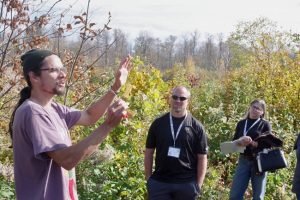
THUNDER BAY — Wiikwemkoong Unceded Territory’s Joseph Pitawanakwat shared three medicine walks and medicine teachings on the second day of the Kinoomaadziwin Education Body’s (KEB) Sharing for Success Education Conference 2026, held October 5-6 in Thunder Bay. Held at the Valhalla Hotel and Conference Centre and Fort William Historical Park, the conference also featured a variety of presentations by other presenters, including Will Morin, Lak Williams, Leanna Marshall, Emily Kerton, and Elliott Cromarty.
“I just appreciate the opportunity to spend time with our educators, these people spend so much time with our kids, and to be able to try to share with them a perspective to carry into the classroom that allows our kids to understand who we are and where we come from and the processes that we ought to be a part of,” says Pitawanakwat, Founder and Director of Creators Garden. “And I get to spend a day and show them in just a few minutes and a few ways that importance of waking that up in our kids — it was very fun to see.”
Morin shared the importance of star knowledge during his presentation on Star Teachings – Literacy Focus.
“Many of our star constellations are connected to our clan animals and can be found in many of our pictographs — our pictographs were not just paintings on rocks, they were actually teachings to help us know how to navigate through the seasons and the changes in the weather and when to hunt, when to harvest, when to plant, and connect us to those animals because they’ve been living in balance,” Morin says. “So those teachings, those star knowledge stories and our traditions, can be benefitted by the more of the language we learn, the more we understand our role in moving forward as Anishinabek people on the land of our Ancestors on how to live in balance, and when we do that we can begin to help others that live here that are not Anishinaabe on how to live in balance.”
Williams and Marshall shared information about fish skin tanning during their presentation on Gaagi Zaagibigaa – Understanding Our Food System and Food Sovereignty.
“We are here to do a workshop on fish skin tanning and softening, that way teachers can use this land-based practice in their classrooms for a hands-on experience with their students that connects people to land, food, water, and have something tangible afterwards,” Williams says.
“Some of the key points are building relationships with the fish and understanding the water systems and the connections that the fish has with us,” Marshall says. “With this workshop we are teaching teachers how to make leather out of their fish skins — this is a practice that’s not something we would have done as Anishinaabe, it was a practice that would have happened with the Indigenous people that are around the oceans.”
Kerton and Cromarty shared a presentation on Niswi, Niizh, Bezhig, Ambe!! (3,2,1, Go!!) – 3 Quick STEM Lessons for Your Classroom, which included a demonstration of a snowshoe lesson.
“As you can see within this one particular lesson, there’s lots of different curriculum that you can cover,” Kerton says. “There’s using measurements to measure the length of the babiche needed to weave [a snowshoe], there’s discussions about what types of materials you get from what parts of the forest, you can talk about different animals and their ecosystems, so like the hare and the lynx and population dynamics between those two types of animals, how predator and prey relationships work, and then of course there’s the direct physics and math that come with stepping down on the snowshoe and your weight distribution across that snowshoe.”
Marlo Beaucage, Systems Principal at KEB, says the teachers, educators, and other participants were participating in specialized learning during the conference.
“There are breakout sessions happening throughout the day gearing towards mathematics, executive functioning for special education, literacy,” Beaucage says. “We have physical education, the traditional teachings of lacrosse, we have birch bark working, and then we come back together for a main plenary this afternoon and listen to star teachings, and that is going to be geared towards working with literacy in the classroom.”