

First Nations leader provides details on reconciliation plans at Rama conference
By Sam Laskaris
CHIPPEWAS OF RAMA FIRST NATION – When it comes to corporate reconciliation, Myan Marcen-Gaudaur is regarded as a leader. But the Chippewas of Rama First Nation citizen believes countless others should also be viewed in the same light.
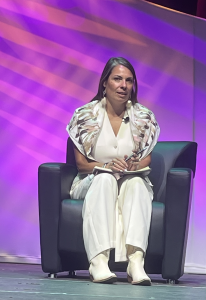
Marcen-Gaudaur has served as Scotiabank’s Director of Indigenous Relations and Reconciliation for the past three years. Her duties include leading the bank’s Truth and Reconciliation Strategy. She was also a panelist at the Forward Summit conference held September 23-24 at Casino Rama Resort in her First Nation.
Marcen-Gaudaur was a speaker during a session titled From Commitment to Courage: Turning Reconciliation and Safety into Action.
Marcen-Gaudaur told delegates that anybody in the room doing reconciliation work is a trailblazer. “And that requires an incredible amount of courage,” she said.
Marcen-Gaudaur also said she loves analogies, adding she believes having courage is the equivalent of having fuel in a car.
“The action plan, or the commitment that a company makes to reconciliation, is like having the vehicle,” she said. “But how is it going to go anywhere. And I think it’s the courage that provides the fuel. It becomes a conduit between the words and the outcome.”
Marcen-Gaudaur was hired by Scotiabank to develop the bank’s reconciliation action plan. The bank’s inaugural action plan was launched two years ago.
“We called it a Truth and Reconciliation Action Plan,” she said. “We can’t really talk about courage without talking about truth and shining a light on the true history of this country. So, I have had to encounter acts of courage, big and small, every single day.”
Marcen-Gaudaur said for some it is not an easy task to work on reconciliation action plans.
“It is so profoundly hurtful and discouraging and heartbreaking when we’re faced with resistance,” she said. “On the other hand, we have been faced with resistance for a long time. So, that’s not really new.”
She also said while doing reconciliation work one needs to understand what no means.
“Is it no or is it not right now,” she said. “And realizing that, one of the biggest mistakes that we make is trying to do too much too soon, without creating the foundation. It’s like building a house and you’re worried about the second floor and the third floor, but you haven’t built out the foundation yet. And so maybe if we’re hearing no in a corporate environment, or we’re feeling resistance, it’s because there’s foundational work that’s missing.”
She believes knowledge and education are often what is missing. That’s frequently the case because of assimilation policies in the country which do not tell the truth of our history.
“In the absence of that, if people don’t know they won’t care,” she said. “And if they don’t care, they won’t act. And so, a lot of our work as leaders in the space has to be going back to that education.”
During her session, Marcen-Gaudaur was asked how organizations can advance reconciliation without being willing to get things wrong.
“I think the biggest challenge is that the idea of getting things wrong is still very much taboo in a lot of corporate environments,” she said. “There’s two paths when it comes to getting things wrong. There is, we got it wrong, and you give up. And you get it wrong, you learn from it, and you get stronger.”
She also said a wise comment she heard from a friend is that curiosity doesn’t hurt but ignorance does.
“If there is a question that you don’t know on a topic, you don’t know tied to Indigenous relations or reconciliation —because I recognize it’s very intimidating and you don’t want to get it wrong —but the silence actually hurts a lot more,” she said. “That is the biggest mistake that we can make on this journey.”
She asked others to be courageous.
“When you have a question because there’s something you don’t know or you don’t understand, please ask,” she said.
Marcen-Gaudaur also offered her thoughts on what action companies should take to make a difference in the reconciliation journey.
“Stay the course at all costs,” she said. “You are all future Ancestors. And we all have an opportunity to lead our descendants to a place where they are living a very different history than the ones we are today. It’s a tremendous opportunity. But it requires staying the course.”