

Hundreds walk and gather for Every Child Matters in North Bay
By Kelly Anne Smith
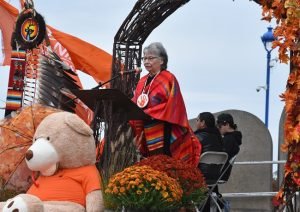
NORTH BAY — The North Bay waterfront was the site of a somber yet hopeful gathering for the Every Child Matters Walk and Exhibition, drawing hundreds of participants for Orange Shirt Day and National Day for Truth and Reconciliation observed on September 30.
The gathering was jointly hosted by Nipissing First Nation, the North Bay Indigenous Friendship Centre, the North Bay Indigenous Hub, and Anishinabek Nation.
The gathering began with participants walking in solidarity along Lake Nipissing, then the large group came together at the Kiwanis Bandshell at Shabogesic Beach.
Grandmother Lorraine Liberty-Whiteduck gave thanks; Boys from the Island offered a Welcome Song.
Indian Residential School Survivor June Commanda, a citizen of Nipissing First Nation, was introduced by emcee Kieran Peltier from the North Bay Indigenous Hub. He announced that the event had smudge, tobacco ties, and was collecting sacred tears. Commanda, who was forced to attend St. Joseph’s School for Girls from 1946 to 1951, spoke to the crowd, who were all wearing orange shirts.
“My life began with a happy family. I had a father and a mother, siblings, and then suddenly, my father died. And we had Indian agents. It was the Indian agent that sent my sister and I and my little brother to the Residential School. We were living in oppression. The Indian Agent word was ‘that was the rule’,” Commanda says. “It was a cold, lonely life. All you thought about was to go home. I wanted to go home. A good home with all my relatives and my community…My mother came and picked us up every end of June when school finished. And then we came back in September. But some kids, they never came home. They had no parents. They may have been from our reserve, but people don’t even know some parts of their families. There were Commandas that never came home. They just went to the nearest reserve near Serpent River. They were like lost children. It was not a good life.”
Commanda said that she and her friends talked about running away from the Indian Residential School. They cautioned about walking on the side of the highway or railway in the daylight. Commanda decided against the plan because she wouldn’t leave her little sister alone at St. Joseph’s School.
“I tried to talk about it, but this one lady scolded me,” Commanda says. “She told me, ‘If you had behaved, you wouldn’t have went there.’ It just built on my guilt complex I have. Once, my sister and I talked about it when we got together. Most of the kids, mostly the boys, my brother being one of them, they couldn’t talk about it. And things were much worse at the boy’s school than at the girls. They were physically and sexually abused. I can just imagine how they felt. They probably had guilt from being abused. Some of them died like that, hurt, carrying that in their life. Many of them were living on the street. And a lot of them went to Toronto because they had no home to go to. Some of them came back after they retired. Nobody knew who they were. They were the lost ones…So, we should always remember them… It was a terrible thing to do. And make sure it never happens again to our people.”
Nipissing First Nation Gimaa Cathy Stevens exclaimed, “What a wonderful sight,” as she looked out at the participants in orange shirts.
“Today, we come together with heavy hearts, but also with strength, pride, love, and hope. We gather to honour the children who never made it home, to recognize the courage of those who survived, and to acknowledge the generations of families who continue to carry the impacts of this painful history.”
At the podium, Anishinabek Nation Lake Huron Regional Chief Scott McLeod acknowledged the many Survivors who were not physically there but endured the long-lasting impacts of Indian Residential Schools.
“There was a piece of Canadian legislation that was aimed at getting rid of the Indigenous people in this country,” he said. “I’m happy to say that they failed. But it didn’t come without leaving many scars in the wake. And for those of you who don’t know, the legislation is still here today. It’s still intact and it’s known as the Indian Act.”
President of the North Bay Indigenous Friendship Centre Maurice Switzer stated it’s very important that the number of people attending Orange Shirt Day keeps increasing. He raised a walking cane that his grandfather, Moses Muskrat Marsden, carved.
“My grandfather ran away from a Day School, a training school they called it, in Alderville First Nation,” Switzer says. “He was eight years old. He had to teach himself how to read and write. He and my grandmother, Nellie Franklin, ended up having over 70 grandchildren. My mother, Ruby Marsden Switzer Hicks, was the youngest of 13 children… Among those 70 some grandchildren were printers, there was an air traffic controller, there were boat builders, there were journalists, there were university professors. I think about all of the people from my grandfather’s family who contributed to making Canada a better country. And I think of the thousands of people who never made it home. I think of the thousands and thousands of contributions that could have been made to this country if they had of made it home, like my grandfather.”
Nipissing—Timiskaming Member of Provincial Parliament (MPP) Pauline Rochefort says she makes the commitment in all her work.
“Reconciliation asks all of us to listen, to learn, and to keep working together towards a better future,” MPP Rochefort says. “A future where young people know the truth, are proud of who they are, and have every opportunity to build the future they choose. That is a future that is worth working towards together.”