

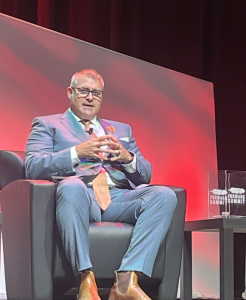
Straub informs conference delegates processes of obtaining loans from crown corporation
By Sam Laskaris
CHIPPEWAS OF RAMA FIRST NATION – People across Canada are no longer simply talking about reconciliation.
These days Indigenous people throughout the country are leading their communities, businesses, and various institutions and reshaping the roles of ownership, investment, procurement, and economic participation.
Kristan Straub, a citizen of Henvey Inlet First Nation, is well versed in encouraging Indigenous participation in economic opportunities.
Straub is the President and CEO of the Canada Indigenous Loan Guarantee Corporation, a crown corporation that can provide loans ranging from $20 million to $1 billion per project.
Straub was also a panelist at the recent Forward Summit conference held at the Casino Rama Resort in Chippewas of Rama First Nation.
He spoke at a September 23 session titled Indigenous Capital, Investment & Procurement: Building the Financial and Commercial Foundations of Indigenous Economic Leadership.
Straub walked conference delegates through the processes Indigenous communities take when involved in major economic development initiatives.
“The first thing to really start with is the sharing part of the community and ensuring that it’s in the community’s interest, that the community wants to go down this path because it is a large and challenging path to go down,” he said. “For many communities who’ve never had any development before, this is the first of its kind.”
It can indeed be an eye-opening experience for those who are participating for the first time in a major deal.
“From my knowledge of our community and our families in the community, communities are set up very differently,” he said. “They’re not set up to participate in major projects from the initiation of it. They’re set up to address the community needs on a short to medium and hopefully when funding is there, on a long-term basis.”
Things change drastically with a significant deal.
“When you’re going to go down the route of being an equity holder in a major project, like a transmission line, transmission lines are constructed for 50-70 years, probably plus,” Straub said. “So, during the life of that asset, like you would find with many other equity assets, it’s built at one time. It lasts for quite some time without having to really do anything other than check on it every once in a while. And then as time progresses, you may need to put some more money into it. Those are things that you have to start to consider.”
Straub also said community representatives must also prepare for various authorizations.
“It may take a band council resolution to get the project started but you’re definitely going to need the community members, and I’ll use the words rightsholders, because at a community level, we’re all the rightsholders,” he said. “The chief and council are elected by us. But it’s us as rightsholders who have to make that decision.”
Straub also said that in many cases others, perhaps other Indigenous communities or municipalities, also have to be consulted before a project proceeds.
Straub, who is also the chancellor for Sudbury’s Laurentian University, also said that the loan guarantee program can be transformational for communities. The program was established to address some inequities that previously existed.
“We will work with the Nations on understanding the cash flows of that business, what does it look like from a construction perspective, what does it look like from an operating perspective,” he added.
Straub also said program representatives are keen the protect the interests of Indigenous groups.
“This is not about protecting the government’s interest or the lender’s interest,” he added.