

Anishinabek Nation forum explores First Nations economic sovereignty and ownership
By Rick Garrick
THUNDER BAY — A proposed First Nations energy corridor was raised during the 4th Annual Anishinabek Nation Economic Development Opportunities Forum, held October 20–22 at the Valhalla Hotel and Conference Centre in Thunder Bay.
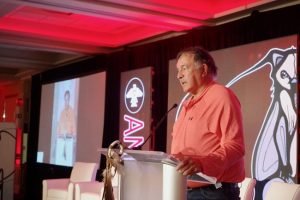
“The Northern Shield Energy Corridor, what does that mean for us as First Nation folks, that doesn’t mean a lot to me because of no opportunity,” says Peter Collins, CEO at Chi Mino Ozhitoowin and a former Fort William First Nation Chief, during the opening keynotes session. “The way we are looking at the Northern Shield Energy Corridor is we are developing our own energy corridor that will run from Hardisty, Alberta, to Thunder Bay. When you hear people talk about ‘if not now, when?’ Well for me it’s now, it’s time for us to take advantage of the economic opportunities that are in front of us today and take control of that. What I mean by taking control of that corridor, we control it as a First Nation organization.”
Collins says he always tells people it is “our time.”.
“When you listen to the economic adventures that are happening in our country today and looking at what the prime minister and the premier are trying to do, and they talk about economic sovereignty,” Collins says. “What does that mean, what about us, what about our economic sovereignty. That’s where I’m trying to take our organization — I do work for a little corporation called Chi Mino Ozhitoowin — what it means is everybody working together in a real good way, and that’s the important message, everybody working together in a real good way.”
Fort William First Nation Chief Michele Solomon and Anishinabek Nation Northern Superior Regional Chief Mel Hardy also spoke during the opening keynotes session at the forum.
“I’m really grateful that I can come to these spaces and listen and learn, and it helps me to be better,” says Chief Solomon. “I think that we’re certainly at a pivotable time for these conversations as we talk about and hear about Bill C-39 and other bills that really push us forward, sometimes not in the way that we would like. Having industry and partners come and join us in these forums, it allows us to say to the government, ‘Hold on a minute, we are building these relationships and we are unlocking our potential, so we don’t need to be thrust into these things in such violent ways, just stand back and allow us to develop these relationships in a trusting and meaningful way as we’ve been doing for many years.’”
Northern Superior Regional Chief Hardy says economic reconciliation is wellness.
“For too long economic development was done to us, and not by us,” Northern Superior Regional Chief Hardy says. “When our youth have jobs, when our businesses own the work, our spiritual, emotional, physical, and mental wellness does improve. My ask for the year of 2026 is let’s move from talk to ownership, from funding to revenue, from partners to partnership where First Nations are equity partners, not just stakeholders.”
Biigtigong Nishnaabeg’s Nicole Richmond, a lawyer, wellness consultant, and educator who recently started up her own law firm, Boozhoo Law, delivered a keynote during the forum on Understanding Who We Are Becoming: Bringing Our Whole Anishinaabe Selves into the Future We Are Creating.
“One of the most important lessons that I’ve learned from an Anishinaabe law perspective is how to be with the water, and one of the things that I’ve learned is how to translate that to Anishinaabe legal principles,” Richmond says. “This word zaagi’idiwin is the word for love, and love is a principle that underlies so much of the work that we do as Anishinaabe people. So, when we think about this word, love, and when we think about what are we doing as Anishinaabe people, how are we creating conditions for the goodness of who we are as Anishinaabe people to flow through us and to come out in a good way.”
Richmond says when she thinks about flowing, she thinks about the way water moves, the way energy flows, and the way that Anishinaabe people create conditions for inclusion and participation.
“I think there are really important implications for all kinds of sectors, law, economic development, child welfare, health,” Richmond says. “How do we let ourselves flow as Anishinaabe people.”
The forum also included the Anishinabek Nation Economic Development Scan, Anishinabek Nation Economic Development Showcase, First Nations Participation in the Alto Project, and a variety of breakout sessions.