

Great Lakes Research Alliance for the Study of Aboriginal Arts & Culture celebrates 20 years
By Laurie LeClair
TORONTO – The Great Lakes Research Alliance for the Study of Aboriginal Arts & Culture (GRASAC) was established in 2005 by a small group of Indigenous scholars and non-Indigenous schools and academics interested in creating an international knowledge-sharing network focused on Anishinaabe, Haudenosaunee, and Huron-Wendat cultures. A very important component of this research involved locating the resting places of Indigenous items, now found in institutions and private collections across the world, and in most cases, thousands of miles away from their original communities. Locating collections and creating mutually beneficial bonds with their current caretakers meant that cultural artifacts (Heritage Items), sacred treasures (Relatives), and textual pieces could be digitally repatriated via a growing database.
GRASAC Knowledge Sharing (GKA) Platform or GKS gives teachers, researchers, heritage workers, and First Nations access to collections, and in return, these Heritage Items and Relatives gain a voice and agency in their curation or present resting place. GRASAC also supports physical repatriation, and when this is not immediately possible, facilitates visits between communities and their once-lost belongings and ancestors.
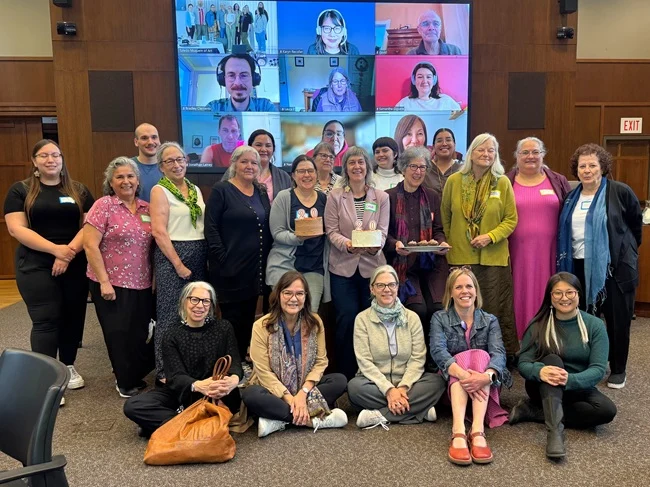
This year marks the 20th anniversary of GRASAC, and to celebrate this special year, GRASAC members held a two-day joint Research Gathering at University of Toronto, Toledo Museum of Art, and around the world via Zoom. Day one focused on the practicalities and challenges of running museums and archives, where participants shared strategies on important topics like digitization, sustainability, and budgets, and tackled challenging subjects like consent and appropriation. In the evening, organizers planned an outing to Toronto’s Rogers Centre and the Blue Jays accommodated with an 8 to 4 sweep of the Oakland Athletics.
On day two, participants, both in-person and on Zoom, were treated to a curatorial tour of the Toledo Museum of Art. Once in the intellectual space of a museum, the following two presentations, GAA Bi Kidwaad Maa Nbiising: The Original People of Lake Nipissing and Visiting Relatives in Germany and Switzerland, helped participants understand the spiritual and emotional toll that is experienced by Indigenous people when they are reunited with relatives, their spirits present in sacred items like drums, clothing, wampum, and beaded items. Interactions like these emphasize the importance of community access to museum collections, but also show the need for discussions over privacy and reverence. The wide range of cultural items considered during these two days, from a tiny silver thimble that someone chose to sew onto her dress a century ago, to military fortifications made sacred by their incursion onto burial mounds, demonstrates the historical breadth of Indigenous material culture and by extension, GRASAC’s ambition in maintaining and growing its database.
Three of GRASAC’s founders, Heidi Bohaker, Darlene Johnston, Ruth Phillips, and Sherry Farrell-Racette, an early member, closed the event with recollections of GRASAC’s past two decades and thoughts for the future. GRASAC’s growing membership now has over 500 people.
GRASAC is proud for not only its 20 years of outreach, inclusion, education, and reconciliation, but also for expanding our collective consciousness on the importance and diversity of Indigenous Great Lakes material culture.
Individuals and First Nations can access GRASAC’s Knowledge-Sharing Network and are invited to share their own stories and information. Go to: https://gks.artsci.utoronto.ca/
To learn more about GRASAC or to become a member, visit: https://grasac.artsci.utoronto.ca/