

Whitefish River First Nation member exploring options to take his coffee business overseas
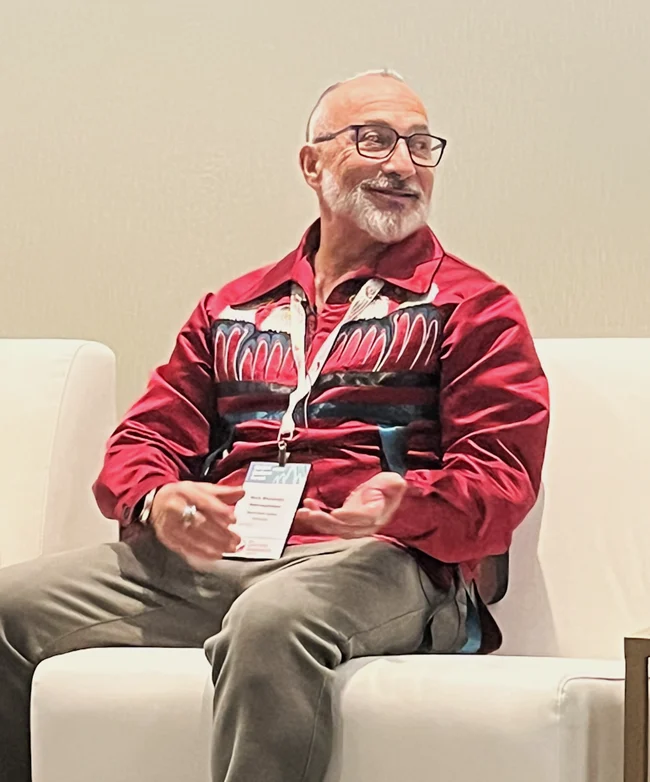
By Sam Laskaris
TORONTO – Mark Marsolais-Nahwegahbow has had some grandiose ideas for quite some time. But the Whitefish River First Nation member, who founded the Birch Bark Coffee Company in 2018, admits it has only been in recent months that he has seriously started contemplating expanding his business abroad.
Marsolais-Nahwegahbow was one of the speakers at the Central Business Forum, hosted by the Canadian Council for Indigenous Business (CCIB), on June 5. The event was held at The Westin Harbour Castle in Toronto.
He spoke at a session titled, Breaking Barriers: Navigating International, Provincial and Treaty Trade. Speakers on this panel discussed the need to find new partners and also how to handle U.S. trade relations, especially since American President Donald Trump has dominated global headlines this year with his international tariff war.
His business is booming as his products are available at various locations, including Costco and Giant Tiger stores nationally. And it was announced at the CCIB forum that Birch Bark has become the official coffee for VIA Rail.
Marsolais-Nahwegahbow said that because of Trump-imposed tariffs, he started thinking whether he needed to have his company in the U.S.
Subsequent meetings with trade commissioners from China led him to seriously start considering taking his products to Europe and Asia.
“I thought this was a really interesting opportunity that we should have been doing this a long time ago, to be honest with you,” he said. “And not just relying on the US, because I think it opens the doors to be able to allow people to see what we have.”
Marsolais-Nahwegahbow explained some of the reasoning which led to the creation of his coffee business.
“Part of my journey was to bring a voice to a lot of the issues, the infrastructure issues in our communities,” he said. “People ask me, ‘Why did you pick coffee?’ I could have picked a bubble gum, I guess, but I picked coffee because it’s a social piece. And you know, with coffee and tea, it gives you an opportunity to come together and talk. And it’s the second most sold commodity in the world.”
He added that Chinese delegates were intrigued about the company’s mission to spread awareness of Indigenous issues via coffee. They said other parts of the world need a company like his, which has a message to spread.
“It’s the story,” Marsolais-Nahwegahbow said. “There’s a story to it. It’s not just the coffee.”
And he’s more than willing to tell others not only the history about his family, but also about what all other First Nations across the country have experienced and what they are dealing with now.
“The story evolves and unfolds, and I think that the different countries embrace it,” he said.
And with American-led tariffs that have been prevalent in the news this year, Marsolais-Nahwegahbow is exploring his options for where to sell his products abroad.
“There’s a lot of moving parts and a lot of logistics behind the scenes to make sure [that happens],” he said. “When I started this business, I wanted to go to every country and said, I’m going to take on the world. As an entrepreneur, you’re just going a hundred miles an hour, and then you get the brakes put on.”
Reality set in when he had to figure out various patents, trade rates, and deal with labelling issues concerning his products.
So, for now, he’ll take a slower approach.
“I’ll just tackle one country at a time,” he said.