

Thunder Bay Museum launches new exhibit exploring the railway’s impact
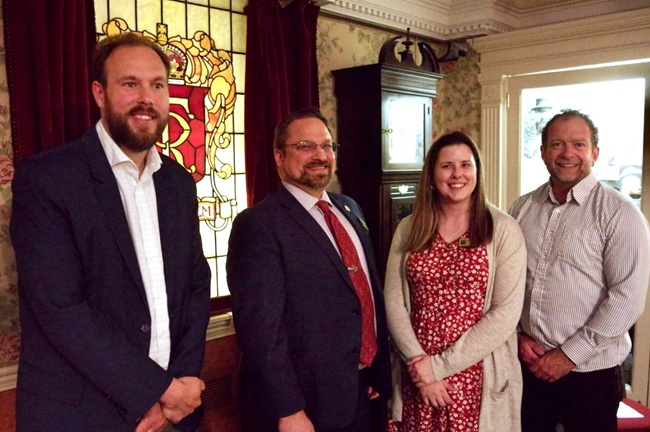
By Rick Garrick
THUNDER BAY — The Thunder Bay Museum launched its Where the Line was Drawn: The Canadian Pacific Railway, Treaties, and the Reshaping of Northwestern Ontario exhibit with an opening reception on June 24.
“The exhibit was very well done by our staff here at the Thunder Bay Historical Museum Society where it did a really good job exploring the railway’s impact on northwestern Ontario and Canada as a whole, both positive and negative,” says Jenna Kirker, president and chair of the Board of Directors at the Thunder Bay Historical Museum Society. “I think it recognizes the colonialism behind [the] railway, but also recognizes that it did have a big role in connecting Canada from coast to coast. The interactiveness of it, I think, is a really big highlight, it’s open, accessible for everyone of all ages, of all backgrounds, and it’s really great that it incorporates not only adults, but youth and children in learning about our region’s history.”
Fort William Chief Michele Solomon says the exhibit is a good capture of the history of the Canadian Pacific Railway (CPR).
“But I don’t think it does justice to the experiences of Indigenous people that were displaced at times because of the railway,” Chief Solomon says. “In particular, I have spoken greatly in Thunder Bay about how Fort William First Nation was displaced in 1905 by the Grand Trunk Pacific Railway. A grain terminus was supposed to be built there, it never was built, but nevertheless, Fort William First Nation had to move all of their buildings, all of their people, their homes. Most sadly, we even had to unearth our ancestors, our cemetery had to be moved for the railway in our community, and that was 55 years after the signing of the treaty.”
Scott Bradley, executive director at the Thunder Bay Historical Museum Society, says the exhibit explores the impacts on Indigenous peoples.
“But the CPR in its inception didn’t have a direct impact on Fort William First Nation in the way that the later Canadian Northern and Canadian National railroads did with the expropriation of land and the movement of graves and other buildings,” Bradley says. “We do talk about the impact of Indigenous peoples here and the influence on the treaties, but the impacts on Fort William First Nation weren’t necessarily centred in this exhibit. In the future, we will probably do an exhibit on the Canadian Northern and the Canadian National Railway and really kind of explore that impact that’s still going on now.”
The Canadian National Railway, which was incorporated in 1919, originated from the amalgamation of five financially troubled railways, including the Grand Trunk Pacific and the Canadian Northern railways.
Thunder Bay-Superior North MPP Lise Vaugeois says the exhibit was fascinating.
“We know there was a lot of displacement of Indigenous communities across the entire country but also through this region and those communities are still struggling today, so I would like to see more of that integrated into the exhibition,” Vaugeois says. “What is here is very interesting, it’s fascinating — there’s also the piece of who did the labour, who were the labourers.”
Vaugeois says the CPR route follows along the northern shoreline of Lake Superior.
“I’ve travelled a lot of the north shore by kayak and you’re always seeing the rail,” Vaugeois says. “Jackfish I’m familiar with and that train is so long, it goes around the entire bay before you see the end of it. There are amazing aspects, the engineering is amazing, the fact that it was even possible to do it is amazing, but it was also part of a political project that was quite destructive and quite arrogant and we can’t afford to forget that.”
Michael deJong, curator and archivist at the Thunder Bay Museum, says they were thrilled to see the turnout and interest in the exhibit.
“It’s really important to us to tell the story,” deJong says. “People have just been marvelling at some of the specific items on display, like the scroll diagrams, some of the remarkable artifacts we have from our collection, but also just the visual interest in the exhibit that took a lot of effort to make it come alive. We’re glad we could tell this sort of complex and multifaceted story of the CPR, we want to recognize the accomplishments of the railway but also talk about the costs of the railway in terms of the dangerous work involved in those who built it, make sure they’re not forgotten, and also recognize the impacts on Indigenous peoples.”
Information about the exhibit, which runs from June 25 to early 2026, is posted online.