

Recognizing Survivors during Thunder Bay’s Indigenous Survivors Day Proclamation Signing and Flag Raising ceremony
By Rick Garrick
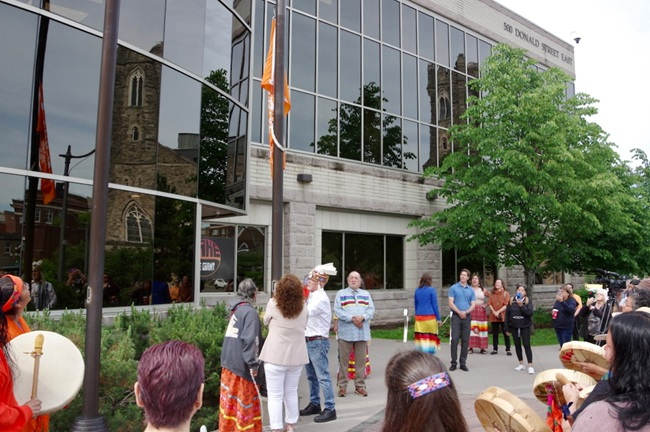
THUNDER BAY — Fort William Chief Michele Solomon and Anishinabek Nation Northern Superior Regional Chief Melvin Hardy stressed the importance of recognizing Survivors during Thunder Bay’s Indigenous Survivors Day Proclamation Signing and Flag Raising ceremony at City Hall on June 30. The proclamation to recognize Indigenous Survivors Day stemmed from a request by Troy Abromaitis, a Sixties Scoop Survivor from B.C., who helped establish Indigenous Survivors Day.
“I’d like to start by first and foremost, acknowledging all the Survivors that are here with us today because this is really at the core of the work that needs to be done and the heavy-lifting that has been done by the Survivors to help us understand better and give us the steps and the information and the knowledge that we need to walk forward together,” Chief Solomon says. “This day is different because it’s about the Survivors, it’s about the experiences that the Survivors have had. September 30 (Orange Shirt Day) is really about Truth and Reconciliation, acknowledging the historic wrongs that have happened through Residential School, and this is more than that. This is really at the heart of the systemic issues that we find ourselves in, the results of the historical systemic issues, not just Residential School, but child welfare.”
Chief Solomon says it was important to hold Indigenous Survivors Day in advance of Canada Day.
“I know that many Canadians are probably challenged with understanding why a lot of First Nations people or Indigenous people have a reluctance to celebrate Canada Day, and I think that this is a good way to bridge those two,” Chief Solomon says. “It’s time that we start to bridge those histories for people to gain that awareness and understanding of why people have that challenge with honouring Canada Day, and it’s because of the traumatic and violent history that we have, but this is an opportunity to begin to move forward together.”
Regional Chief Hardy says they gathered to honour the strength and resilience of the Indian Residential School Survivors.
“[Their] stories, though painful, are a testament of their courage and determination to heal and share the truth,” he says. “Storytelling is a powerful tool for healing. By sharing their experiences and listening to the Survivors, we can begin to process the trauma and find closure. Reconciliation requires acknowledgement, empathy, and action — we must work together to address the historical injustices and ongoing disparities faced by Indigenous communities. Healing is possible through ceremony, community support, and self-care.”
Greg Johnsen, acting mayor and city councillor at Thunder Bay, says the City of Thunder Bay acknowledges the profound and ongoing impacts of colonization, forced assimilation, and systemic discrimination.
“By proclaiming June 30 as Indigenous Survivors Day, the City of Thunder Bay seeks to create a meaningful platform for healing, education, and dialogue through community-led initiatives such as traditional blanket ceremonies, storytelling, cultural performances, workshops, and gatherings raising awareness of the ongoing challenges faced by Indigenous Survivors and their families, celebrating their resilience, fostering a more inclusive, equitable, and reconciled city for all,” Johnsen says. “The City of Thunder Bay reaffirms its dedication to reconciliation, respect, and inclusion, and remains committed to the implementation of the Truth and Reconciliation Commission of Canada’s Calls to Action, the United Nations Declaration on the Rights of Indigenous Peoples, the Calls for Justice of the National Inquiry into Missing and Murdered Indigenous Women and Girls, and (Thunder Bay’s) Anti-Racism and Inclusion Accord while working to meaningfully integrate Indigenous knowledge, voices, and leadership into the city’s programs, services, strategies, and public spaces.”
Thunder Bay’s Indigenous Survivors Day also included a Community Gathering at Hillcrest Park, as well as All-Day Educational Displays at City Hall, the Thunder Bay Museum, and Nishnawbe Aski Nation’s board room and Workshops and Community Information Booths at Nishnawbe Aski Nation’s board room.