

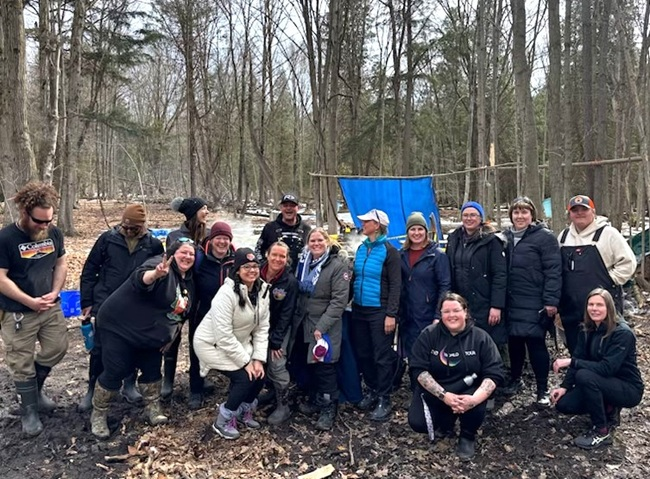
First Nation members digging their community garden project
By Sam Laskaris
MISSISSAUGAS OF SCUGOG ISLAND FIRST NATION – It took some time to get off the ground, but representatives of Mississaugas of Scugog Island First Nation are thrilled they have a thriving food security/employment initiative.
Mississaugas of Scugog Island First Nation Chief Kelly LaRocca said talk of the project surfaced shortly after she first became Chief a dozen years ago.
“I guess it would have been probably back in and around 2013 or so,” she said. “We talked about having a, what we called, an employment readiness program. We wanted to create opportunities for people to engage with, like a community garden project and just get them some skills for greater employability.”
Representatives from the First Nation also wanted their members to engage with each other in the community out on the land.
But Chief LaRocca said the project concept became complicated. Some people wondered if it was an employment readiness venture or actually a food-securing venture. Another thought was if this was intended to be a program for at-risk people.
Chief LaRocca felt it was a combination of all.
“We were kind of brainstorming ideas about how to handle this, the growth of the program, and we thought, well, maybe we’ll team up with some partner organizations and see how they do similar things in the wider community,” she said. “And that just ended up kind of over-complicating things.”
The program creation then stalled for a few years because the First Nation had other issues to deal with.
And then the COVID-19 pandemic hit. During this time, officials from the First Nation were able to provide some food and wellness boxes to its members.
“When we did that, people were really appreciative and they enjoyed it,” Chief LaRocca said. “So, we thought, when we came back from the lockdowns, we should really get this program discussion underway again.”
One idea that became reality was that the First Nation decided to raise some cows. Some area land was purchased, staff was hired, and some younger members of the community got involved.
“We’re a small community and so we didn’t feel we needed a whole lot of cattle,” she said. “We did eight cattle this past year. It was very successful and we have a meat distribution program at Christmas time. And it worked very well. People feel that it’s a good way to obtain good quality, local-raised beef.”
The First Nation now has two full seasons of cattle raising under its belt, and one full season of a community garden project.
“That has been very successful, too,” Chief LaRocca said. “We had more yields than we could even eat as a community. It was a lot, and ended up putting some of our produce in our store, actually. But it was wildly successful program. I’m so proud of the community because they’re very invested in it. They take great care of it.”
More than 20 people are involved in the program, which produces various types of vegetables, corn, and some Indigenous plants.
“We’re trying to learn the skills ourselves so that we can provide for ourselves and not have to rely on as much on surrounding economy in order to obtain good quality, cost-effective food,” Chief LaRocca said.
While the program took some time to get off the ground, Chief LaRocca said she’d prefer not to focus on that.
“I’d rather focus on the reality, which is COVID intervened and, unfortunately, it had to wait,” she said. “But it was worth the wait, that’s for sure.”
Chief LaRocca added that community members are fully supportive of the project.
“It just feels very natural that the whole thing has progressed the way it has and people are ready and they’re totally committed and digging in, pardon the pun,” she said.
Chief LaRocca added that some funding was obtained, which has allowed for free food distribution to the 80 members who live on the First Nation.
“The members know that if it came to us using our own source revenue, we might not be able to carry that on and charge something minimal,” Chief LaRocca said. “But right now, it’s just a really good project to try and help people’s rising food costs.”
All of Mississaugas of Scugog Island First Nation benefit from the program, even if they don’t help out with the community garden.
“A lot of the members that don’t help out are working full-time jobs,” Chief LaRocca added. “And then some are Elders and they have mobility issues. So, it’s a way of community taking care of community.”
Those who do work on the program do receive an honorarium.
“It’s minimal, but we just thought people’s time is valuable,” Chief LaRocca said. “And we want to give them a reason to get up and build those skills and show them that we think and we support that they have value.”