

Book review: Michigan’s Ke-che-te-go Warriors
 Reviewed by Karl Hele
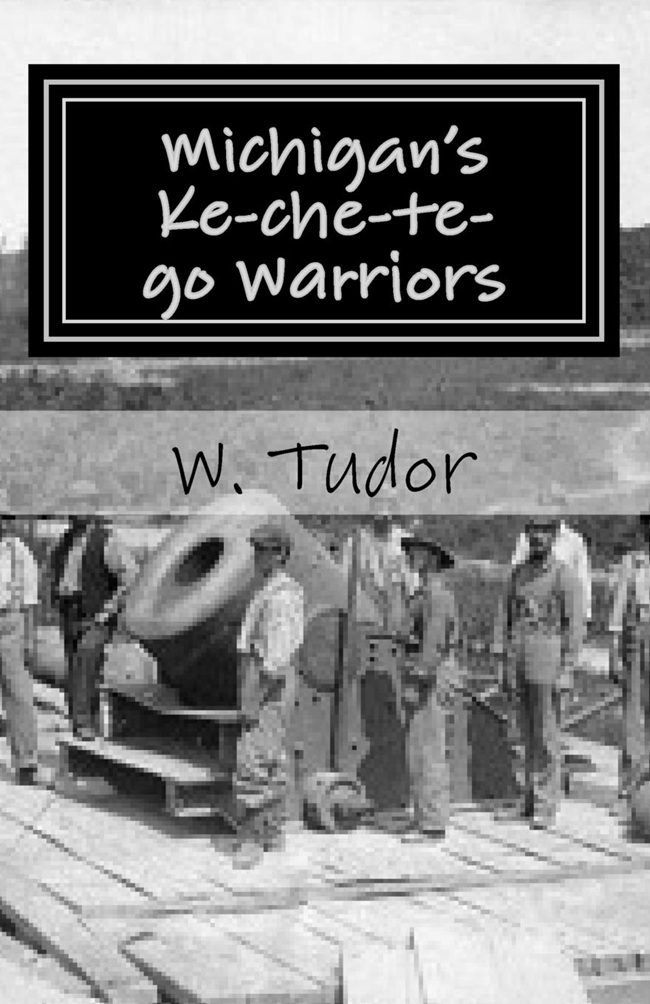
W. Tudor’s historical novel, Michigan’s Ke-che-te-go Warriors, traces three generations of Odawa men – Ke-che-te-go, Abraham Ke-che-te-go, and Thomas Ke-che-te-go. By spanning three generations, from the mid-eighteenth to early-twentieth century, Tudor uses historical fiction to explore the changing landscape of Indigenous Michigan, colonialism, survivance, adaptation or resilience, and pride in being ‘Indian’. Being a work of fiction, Tudor takes liberties with conversations, thoughts, and associations of the three men, yet remains faithful to the events and the choices each man was compelled to make. Tudor notes that educated guesses about the first two generations were more necessary than for the well-documented life of Thomas. Overall, while not a fast-paced story, the novel does a marvellous job of exploring the lives of three Odawa men who were faced with an ever-changing world brought on by the increasing presence of Euro-Americans in their Anishinaabeg homelands.
The novel begins in 1763 with Ke-che-te-go, a boy of about 13 years, and ends with the death of Thomas Ke-che-te-go in 1916. Each subsequent generation is shown as trying to remain true to Odawa/Anishinaabeg ways while adapting to the changing world. The initial chapters follow Ke-che-te-go’s growth as he becomes a teen, hunter, warrior, and father struggling with a world in flux. For instance, in Chapter 4, Ke-che-te-go returns home after a hunting expedition to be greeted by his wife, Stands Apart, and their newborn (b.1780) and named son. Ke-che-te-go is upset by Stands Apart’s adherence to the new Catholic faith and rejection of tradition, as evidenced by her allowing the priest to name their son, Abraham (78).
Chapter 5 is the sole chapter that focusses on Abraham. It offers a generational shift as Abraham realizes his father is dying, receives his father’s dearest possession – a musket named Moonlight – relocates to the Saginaw region, and shifts to being ‘Ojibwa’ and participates in the War of 1812. Chapters 6 and 7 follow the shift from Abraham to Tom, as well as the increasing displacement and impoverishment of the Ojibwa around Saginaw. Despite poverty, racism, and increasing land loss, these two chapters show a resilience within the Ke-che-te-go family and their Ojibwa neighbours, adapting to new realities while maintaining connections to the old ways.
The remaining chapters, 8 through 16, focus on Tom’s life, his service in the United States Civil War, work as a lumberman, and declining years until his death in 1916. This section of the novel really focusses on Tom’s efforts to support his family by walking with one foot in each world. According to Tudor’s novel, with some difficulty, Tom is able to succeed in earning the respect of his fellow Odawa and Ojibwa, as well as from the Settler society. Tom Ke-che-te-go is served up as a successful ‘Indian’ driven by the desire to live a good, balanced life that would draw both him and his family from poverty. Interestingly, I found that Tudor seems to have missed the idea of a ‘balanced good life’ or Bimaadiziwin, instead, casting Tom’s efforts to remain Indian while living and working in a white world simply as a means to support his family and escape poverty. Nonetheless, by following three generations of Ke-che-te-go men, Tudor does a good job of illustrating adaptation to change and the difficulties thereby entailed.
Michigan’s Ke-che-te-go Warriors is a story of personal, familial, and cultural resilience within a family of men who honoured tradition while learning to adapt to a new world dominated by Euro-Americans. Throughout the novel, and with the license that fiction allows, Tudor ably illustrates the effects of dislocation, poverty, land loss, disease, death, and violence on Michigan’s Indigenous peoples. The changes and challenges faced by the Ke-che-te-go men and their neighbours make for arduous reading, yet these individuals’ failures and successes drive them forward with each seeking to make their mark in life.
I would recommend anyone with an interest in fictional biographies or historical fiction to read this novel. This work should also be read by those seeking to read stories of resilience. My only caveat is that Michigan’s Ke-che-te-go Warriors has the occasional slippage of language and styling, indicating that the author is telling the story from a non-Indigenous perspective. Regardless, it is a good novel that draws on themes of resilience, survivance, colonialism, and pride in being Indigenous. Simply, it is a good read and a good story about how three men across three generations, spanning change over a 150-year period, met vast changes and challenges faced by Indigenous peoples in Michigan from the mid-1700s to the early 1900s.
W. E. Tudor, Michigan’s Ke-che-te-go Warriors. Roscommon: N.P., 2014.
ISBN 1497545854