

Book review: Beyond the Rink: Behind the Images of Residential School Hockey
 Reviewed by Karl Hele
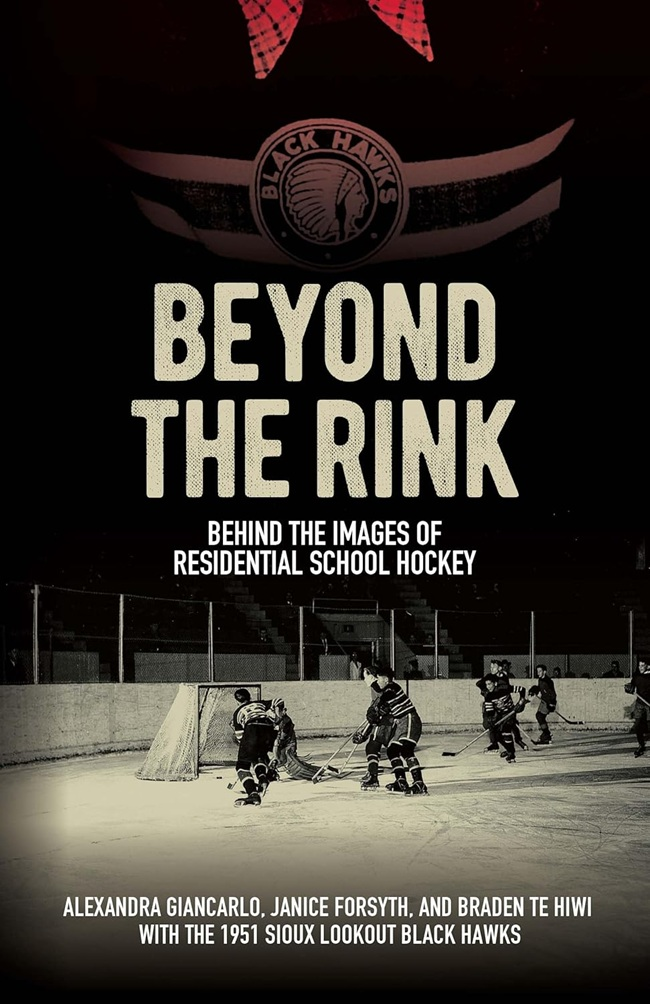
Beyond the Rink: Behind the Images of Residential School Hockey is a compelling exploration of colonialism, hockey, and the experiences of Indian Residential Schools. Through the skilful combination of oral interviews, images, and written records, the multiple authors deftly show the complicated legacy of sport in Residential Schools. The focus of the book is the 1951 Sioux Lookout Black Hawks hockey team’s promotional tour that took the team to Toronto and Ottawa.
During the tour, an official National Film Board photographer accompanied the boys with the intent to document the positive and successful nature of sport for Indigenous children, as well as the benefits of the Indian Residential School System. This propaganda-driven narrative, designed to reassure Canadians, is contradicted or defeated through the memories and recollections of three surviving team members – Kelly Bull, Chris Cromarty, and David Wesley. While Kelly, Chris, and David offer fond memories of playing hockey and the tour’s impact on them and their teammates, the fuller picture of the sport and school emerges. Simply, the memories speak of hockey as a positive, as an escape from the brutality and monotony of school life, as well as the impact the Residential School had on the team’s post-schooling lives. Finally, at its heart, the book is about survivance, restorying, and repatriation as well as the past, present, and future for Indigenous communities, survivors, and their families.
Beyond the Rink’s use of images and oral histories to develop a compelling narrative sets a precedent for scholars and non-scholars to see beyond the photograph’s supposed narrative. In other words, photographs generally, and those of the 1951 hockey tour specifically, are worth more than a 1,000 words. The story of Kelly, Chris, and David, as well as the ‘silent’ teammates, is unfolded over the course of seven chapters. Chapters 1, 2, and 7 specifically explore the visual narratives in photographs and how these can be misleading or used to tell a desired narrative that glosses over part of a story, whether undertaken by the government, in the case of the hockey tour, or in other cases by a personal desire to focus on the positive or fun times in life. Nonetheless, these three chapters draw heavily on the 1951 images and the meanings the government sought to create, how the public may have understood them, and what the boys saw or remembered when reading the images. Chapter 3 discussed how sports photos from Residential Schools and the 1951 tour were meant to illustrate the assimilative goals of the schools being achieved by teaching students about white masculine ideals of fair play, competition, and teamwork. Chapters 4, 5, and 6 narrow the focus to Pelican Lake Residential School, the Black Hawks, and the 1951 tour. These chapters deftly explore how hockey provided the boys with an escape, a sense of equality, and a window into the larger world. Overall, by centring the study on a specific school, team, and event, the authors demonstrate the complexity and myriad of meanings for Canada’s game.
Beyond the Rink, at its core, is the story of Survivors – Kelly, Chris, and David. While the focus is on understanding the multiple meanings contained within and associated with photographic images and hockey, Kelly, Chris, and David’s memories of their experiences bring the work to life. The book nicely shows that the smiling images of children in Residential School photographs do not indicate an overall positive experience. These images have captured moments that are both unscripted and, albeit more often, scripted to tell a particular narrative. This propagandist narrative is undone when Survivors’ memories are freed through the viewing of these snapshots as ‘constrained’ and ‘interrupted’ childhoods with family and community.
In examining the Sioux Lookout Black Hawks’ experiences through memory and images, a vibrant picture of the complex nature of sport at Residential Schools unfolds. Overall, the history presented offers a complicated restoration of sport and state-sponsored imagery set against the backdrop of residential schooling. As such, this volume is a wonderful contribution to the examination of the history and legacy of residential schooling in Canada. The down-to-earth writing style, the ease of explanation, and the narrow focus lead the reader easily from chapter to chapter. While potentially triggering, the work’s central message is that hockey and sport offered an escape, provided some good memories, and potentially made a positive impact on children’s lives while they lived experienced colonial and assimilative policies designed to destroy their culture and connections to family and community. The work also serves as a reminder that a ‘positive’ memory or image does not equate with the experiences of children in the Indian Residential Schools. Hockey may be Canada’s national pastime, but its utilization as a propaganda and assimilative tool certainly complicates the sport as an entirely positive tool and national icon. As such, I would recommend this incredibly educational book for high school through university students, community members, and sports fans.
Alexandra Giancarlo, Janice Forsyth, Branden Te Hiwi, and the 1951 Sioux Lookout Black Hawks. Beyond the Rink: Behind the Images of Residential School Hockey. Winnipeg: University of Manitoba Press, 2025.
ISBN 1772841064