
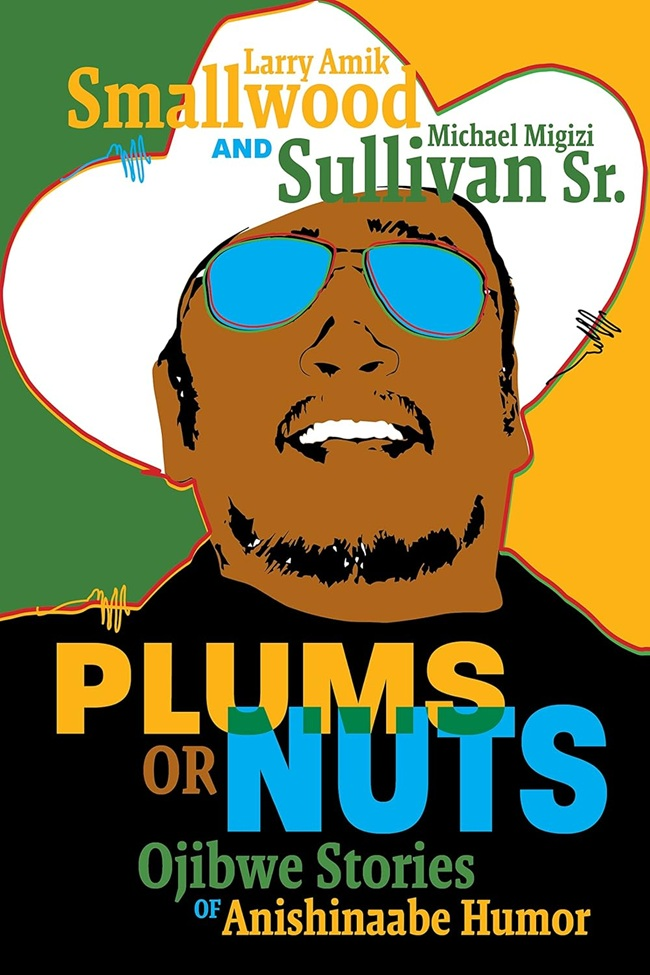
Book review: Plums or Nuts: Ojibwe Stories of Anishinaabe Humor
 Reviewed by Karl Hele
Plums or Nuts: Ojibwe Stories of Anishinaabe Humor is a bilingual collection of 25 stories shared by Larry Amik Smallwood with Michael Migizi Sullivan. Each story encapsulates aspects of Amik’s Anishinaabe humourous storytelling about his life and those of people he knew. As a first-language speaker, language teacher, emcee, and beloved Elder, Amik wanted to share his love of Anishinaabemowin through its humour and his unique style of expression. Every story appears in English and Anishinaabemowin. As a text, Plum or Nuts is more than just about language and humour; it is also about a zest for life, generally unvarnished reflections on an individual and communities’ past, and an educational guide for speakers and learners of our language.
Each story originally spoken in Anishinaabemowin was transcribed and translated by Migizi, before being reviewed by Amik. Migizi followed Amik’s recommendations on editing both language texts to ensure the heart of the story and its lesson were conveyed as accurately as possible. Their intense and collaborative approach to Plum or Nuts gave birth to a wonderful collection of stories. Although Amik is gone, Migizi recommends readers wishing to learn more and hear the language as spoken by Amik listen to the audio recordings housed at The Ojibwe People’s Dictionary.
The stories generally trace Amik’s life story from childhood to adulthood. Some of the stories focus on incidents when he was younger, such as being bit by a ground squirrel after chasing it into a tree (Chapter 3) or the first time he officiated at a funeral and may have confused the Anishinaabemowin words for plums and nuts (Chapter 25). Other chapters are humourous stories about family, friends, community, or just retellings of stories that were shared with him. For instance, Chapter 2 relates the story of a friendly non-Anishinaabe storekeeper purposely being given the ‘incorrect’ translation of “Hello, my good friend” – “Aaniin bagonez”. Many of us can relate to being given ‘incorrect’ and often ‘inappropriate’ sayings in another language for the locals to laugh about. Well, the storekeeper was eventually told by a woman to stop greeting people with “Hey, you, with the hole” (19-21).
Other stories, while funny, have dark undertones. In “Chapter 5: Hot Water”, Amik spoke about how Anishinaabe people would do something to get locked up long enough to avoid freezing to death. In this story, a man walked into a liquor store, asked the clerk for a bottle, and when presented with the bottle, proceeded to chug it. When arrested, he humourously argued with the arresting officer that the clerk gave it to him as a gift (33-35). The unflinching narration of each story, no matter the topic, may ‘offend’ modern sensibilities, but as Migizi notes in the introduction, Amik “was a master of Anishinaabe shock humor, saying things that were drastically inappropriate by mainstream standards – but he and many others insisted on the teaching of our humor and our standards! … nothing was off limits for a good joke” (xi). It is the adherence to “our humor and our standards” that make this collection so marvellously educational.
Honestly, I would recommend this work to any Anishinaabe reader or language speaker for the laughs it engenders. More to the point, the text is an excellent teaching guide for Anishinaabemowin learners and those wishing to expand their vocabulary or simply experience reading stories in our language. Amik, through Migizi and the stories in Plum or Nuts, sought to inspire Anishinaabe to learn, speak, and take pride in our language and humour. This text surely hits its mark.
Larry Amik Smallwood and Michael Migizi Sullivan Sr., Plums or Nuts: Ojibwe Stories of Anishinaabe Humor. St. Paul: Minnesota Historical Society Press, 2023.
ISBN 1681342669