

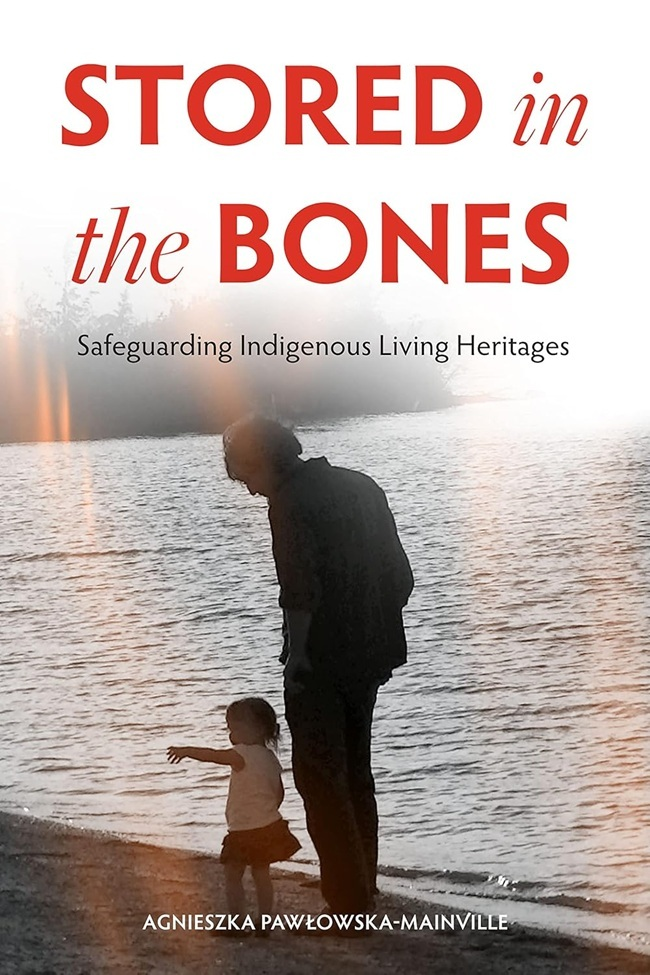
Book review: Stored in the Bones: Safeguarding Indigenous Living Heritages
 Reviewed by Karl Hele
Stored in the Bones: Safeguarding Indigenous Living Heritages is an informative and fascinating study that advocates utilizing the concept of intangible cultural heritage (ICH) to protect, maintain, and continue living Indigenous cultures and knowledges. In so doing, Pawłowska-Mainville is offering additional ways to engage in not only protecting culture, but in protecting treaty, land, environment, and Aboriginal rights. The title of the work draws from a lesson given to the author by Richard Morrison that knowledge is stored in stories and those stories, drawing on generations of experience, are known so well that “they are stored in your bones” (6).
ICH is the cultural heritage of the everyday, of actions, stories, oral traditions, cultural landscapes, lessons, language, and more that are passed from generation to generation, forming the core of culture (229). These are often ‘unseen’ in the sense that ICH is akin to placing tobacco in thanks, in recognition, in offering, that would cease to be if not passed to the next generation.
To illustrate her arguments about the need for communities to undertake ICH surveys and begin to protect this heritage, Pawłowska-Mainville draws on 15 years of research, personal experiences, and lessons from Cree and Anishinaabeg Knowledge Keepers in Manitoba and Northwestern Ontario. These men who lived on the land, trapped, travelled, and engaged in learning from the lands, shared stories, and lessons with Pawłowska-Mainville that bring her book to life. These stories are contained in five chapters, offer a clear explanation of ICH with examples of its importance for community health, longevity, and protecting their lands and culture. Pawłowska-Mainville makes use of Anishinaabemowin and Inninumowin terms to express concepts and practices that are, at best, too simplified, misconstrued, and occasionally twisted when translated into English. The glossary appears at the front of the book, which allows the reader to familiarize themselves with the terms and their brief explanation in English before seeing the more lengthy explanations within the text. I really appreciated the use and explanations of these often complex terms and expressions. For instance, ‘gikendamowin’ is translated as ‘knowledge, way of knowing, process of knowledge creation, an aggregation of knowledge from personal experience and from the larger culture’(xv). This concept is then explored through the examples of the lives of the Elders’ stories, experiences, and lessons imparted to Pawłowska-Mainville, helping you to truly understand how it is “Stored in the Bones.”
Finally, there are three appendices that offer information to anyone seeking to engage with Knowledge Keepers about the intangibles in culture, and determining which intangible aspects are key, in danger of disappearing, or viewed as incredibly important to pass to subsequent generations. The important aspect of ICH is its community-driven, community-controlled, and community-owned aspects. That is its key and importance – ICH is about community. It is not about collecting materials for academic articles, government archives, or corporations. ICH can contribute to these things, but remains within the community to determine how it is shared, what is shared, when it is shared, why it is shared, who it is shared by and with, and how the benefits of sharing are brought back to the community or individuals. Pawłowska-Mainville also notes that Canada has not accepted or enacted the 2003 UNESCO Convention on Safeguarding Intangible Cultural Heritage, while other countries have. She hints that perhaps Canada’s reluctance to sign the 2003 Convention is its potential impact on assessments concerning development projects on Indigenous lands. For instance, current assessments deal with key or important species impacts while ignoring cultural teachings and non-key species (i.e., squirrels, mosquitoes, etc.) that form a united interlinked part of the Indigenous culture being impacted. The intangibles may also help inform the Van Deer Peet test of a right being recognized only if it is central to the culture by showing connections, knowledge, and cultural meaning missed by Western-defined assessments (223-6). Regardless, ICH is simply important to document by and for a community to ensure its cultural uniqueness, survival, and resilience.
While the tone of Stored in the Bones: Safeguarding Indigenous Living Heritages becomes a touch preachy and focussed on the notion of loss, it is an excellent clarion call for the importance of recognizing Intangible Cultural Heritage by everyone. More specifically, it is an excellent argument and guide for documenting ICH by and for Indigenous peoples and communities across Canada. ICH will help in a multiplicity of ways – tangible and intangible. I highly recommend that communities read this book and work on implementing ICH studies, perhaps teaming up with university faculty who can potentially access grants. Or, simply undertake the work in-community through the hiring of summer students. In fact, Stored in the Bones lends itself to community-engaged learning practices and the Indigenizing of academic courses. Overall, it is a monograph aimed at community and researchers interested in ‘new’ ways to protect, promote, and grow Indigenous knowledge in communities and across generations. It is really a must-read.
Agnieszka Pawłowska-Mainville, Stored in the Bones: Safeguarding Indigenous Living Heritages. Winnipeg: University of Manitoba Press, 2023.
ISBN 1772840467