

Long Lake #58 paving the way for students through education
By Rick Garrick
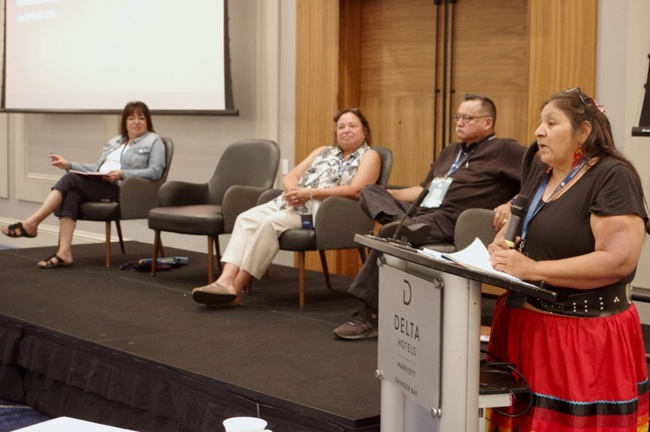
THUNDER BAY — Long Lake #58 Chief Judy Desmoulin and education director Claire Onabigon highlighted their community’s education system during Nishnawbe Aski Nation’s Education Jurisdiction Summit 2025: Best Practices for Reclaiming Jurisdiction. Held July 23-24 at Delta Hotels Thunder Bay, the Summit included a presentation by Chief Desmoulin and Onabigon on The Anishinabek Education System: The Long Lake #58 Experience – Transitioning to a New Education System, and a panel discussion on Creating a First Nation Education System by Desmoulin, Onabigon, Tracey O’Donnell, legal counsel, Anishinabek Education System, and Anishinabek Nation Commissioner on Governance Patrick Madahbee.
“There’s a whole reason why schools even exist in Canada — it’s to prepare the minds for the society that they are expected to live in,” Chief Desmoulin says. “When this information came to me, I turned it around and I thought, ‘OK, we can use this sort of system to help shape and support our minds as Indigenous people because [for] far too long, they tried to make us be somebody we weren’t.’ So with an opportunity like this, we have every opportunity to shape the way that we were meant to be.”
Chief Desmoulin says her community now provides education for citizens from 18-months-old to the oldest adults. Long Lake #58 has an elementary school and a secondary school for students up to Grade 12.
“We have an adult ed program as well, so we accommodate the adult classroom learning in the evenings,” Chief Desmoulin says.
Chief Desmoulin says Long Lake #58 got involved early with the Anishinabek Nation’s Kinoomaadziwin Education Body Anishinabek Education System. The Anishinabek Education System includes 23 Anishinabek First Nations with about 25,000 citizens and about 2,000 on-reserve students from Junior Kindergarten to Grade 12. Information about the Kinoomaadziwin Education Body Anishinabek Education System is posted on their website.
“I was one of the key people that responded at the time,” Chief Desmoulin says. “We gathered there with no resources, no money to get to meetings or anything like that, but we made it work, and to make a long story short, I am very satisfied with what we have now, we have more than enough to do what we need to do. But again, we still have our community issues to solve — we’re still coming out of and dealing with all of the atrocities that have happened to our people.”
Chief Desmoulin says Long Lake #58 had seven Grade 12 graduates over the 25 years before they opened up their own schools in the community.
“So the same period of time, 25 years later, we have 90 graduates, so we’ve done … a lot better job than anybody else when we took over and did it ourselves,” Desmoulin says. “Change is scary and in this process, when we started there was lots of unknowns, but you deal with those unknowns one at a time, and it was worth it. When you’re in the driver’s seat going through those unknowns, you gain the confidence.”
Onabigon says Long Lake #58 is the only one of the 23 Anishinabek First Nations that has both elementary and secondary schools.
“Our schools are student-centred and we focus on our children and youths’ well-being,” Onabigon says. “For our students’ spiritual well-being and for spiritual programming, we now have a teaching lodge, a sweat lodge, we have Elders in the classroom, cultural teachings, we have another curriculum, History through Our Elders, and then we have our annual language and culture days.”
Onabigon says they are planning to develop a language and culture education department, noting that culture and language is the basis of what they do and how they meet the needs of their children.
“We’ll have a cultural coordinator and a language coordinator who will oversee the department; they will research and determine what programs and aesthetics are needed to make us unique Anishinabek schools,” Onabigon says, noting that the language and culture education department will also include two language instructors, two language EAs and a land-based coordinator and teachers. “The reason I say aesthetics is because currently, you could take our school and put it in any city or town and it would fit right in because it looks like a provincial school, so we need to make it unique to us, make it unique to the Anishinabek at Long Lake #58.”
Onabigon also detailed many of the advancements they have achieved in their schools through the Anishinabek Education System funding.
“Because of that funding, we are able to do so much more for our students and our community,” Onabigon says.