

Conference attendees provided details on program involving well-being workers on police calls
By Sam Laskaris
CHIPPEWAS OF RAMA FIRST NATION – Vicki Christie has plenty of experience when it comes to helping others.
She worked in child welfare for more than 16 years and has helped a First Nation build its child well-being program.
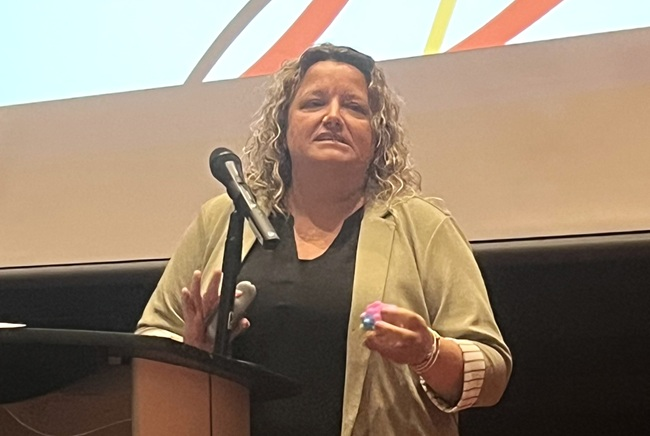
These days, Christie is serving in a new position with a program titled The Pathway Helper, an Anishinabek Police Service (APS) initiative. She provided details of the program during the Anishinabek Nation’s family well-being conference held July 29-30 at Casino Rama Resort, located at Chippewas of Rama First Nation.
The conference, titled ‘connection, care, courage’, attracted frontline workers from across Ontario who work in Anishinabek Nation’s family well-being departments.
Christie explained how the new program includes well-being workers who go along when police have a mental health or crisis call involving an Indigenous person.
The Pathway Helper program helps address issues including addiction, mental health, and homelessness in Anishinabek communities. The program strives to help those in need get the proper support that they require.
Christie said there has been a significant increase in a number of issues that APS officials are dealing with.
She is located in located in Wasauksing First Nation’s cluster, which also covers the First Nations of Shawanaga and Magnetawan. During the last six months alone, traffic stops or warrants in her coverage area have resulted in the seizure of numerous guns and ammunition and large amounts of drugs, including fentanyl.
“A lot of the fentanyl is being made in China, transported to Mexico, comes up the border to B.C., and is distributed from there,” Christie said. “So, Canada does have a significant fentanyl problem. And we’re seeing it in a variety of ways.”
Christie also said that after officers seize fentanyl, it could take up to six months for it to be analyzed to ensure that it is what it indeed is. As a result, some traffickers are going to court and taking pleas and they’re in and out of jail before fentanyl is properly investigated.
“This is potentially in homes in places with people that you’re supporting,” Christie told conference attendees, adding her talk was geared towards keeping them safe. “I am not the authority on it. But I believe I definitely have a skill set around it from experience.”
Christie warned those at the conference not to be naïve.
“If you think fentanyl is not in your community, it is,” she said. “If people are saying to you, ‘Oh, I’m just doing cocaine, I don’t do fentanyl,’ trace it back.”
She said an individual she knows was recently hospitalized. It turned out this person’s system had high traces of fentanyl, despite the insistence that only cocaine was being used.
“But it’s out there and it’s a path people use to lace things to get you into other things,” Christie said.
She also provided some staggering statistics, including that 45 per cent of people living in a First Nation have had some sort of police involvement in the past year. Adding that the suicide rate in Indigenous youth is six times higher than non-Indigenous youth. Also, one in four Indigenous people in Canada suffers from an addiction compared to 17 per cent of the general population.
“I think, [it’s a] personal biased opinion, is that it relates back to the trauma,” Christie said, adding that Indigenous losses from colonialism and the Indian Residential School System are still having lingering effects.
Christie added that it also explains why Indigenous people are more likely to have experienced violence in their lifetime. She said research suggests that links can be traced back to the consequences of Indian Residential Schools, marginalization, and institutionalized racism.
“These policies have resulted in the destruction of community and family structures,” Christie said.
Christie said well-being workers need to set expectations while performing their duties.
“Know what you are going there to do,” she said of requested calls for assistance. “If you need consent forms, if you’re going to talk about industry standards, know what you’re going to talk about. And if you don’t know, tell people I don’t know what the answer is because if you are untruthful to people, that’s going to raise their anxiety.”