

Details of complex trauma of First Nations peoples provided at Toronto wellness conference
By Sam Laskaris
TORONTO – Carol Hopkins has received numerous accolades for her work over the past 20-plus years involving First Nations addictions.
One of her accomplishments was being appointed an Officer of the Order of Canada in 2018.
Hopkins, a member of Delaware Nation at Moraviantown in southwestern Ontario, is the executive director of the Thunderbird Partnership Foundation, a leading voice on First Nations mental wellness, substance use and addictions in Canada.
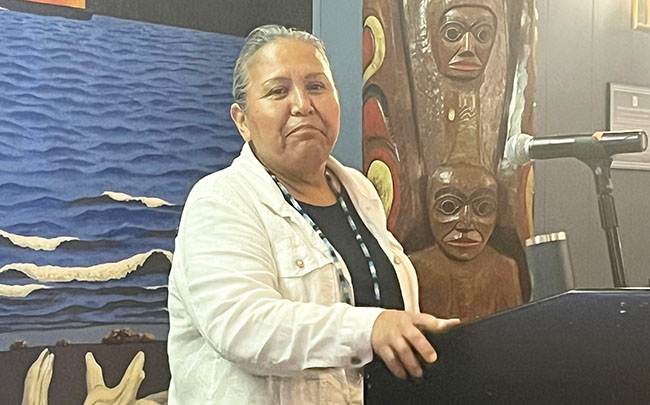
Hopkins was also a presenter of a workshop at the First Nations Community Wellness Conference, which was held Aug. 19-21 at Fairmont Royal York in Toronto. The event was organized by the Chiefs of Ontario.
Hopkins detailed some of her foundation’s work during a session titled Defining First Nations Experiences of Complex Trauma. That work is based on Indigenous knowledge.
“Our world view is rich with absolutely everything we need to live life in a good way,” she said. “But through colonization, all of those words you used to describe violence, colonization fits in there. It’s the experience that we have that we don’t even know is happening around us, but yet it settles within our being, like poison in our blood. And it informs the way we think, how we see life and how we interact with each other.”
Hopkins said governments have set Indigenous culture and knowledge aside when mandating services.
“The government has said to us ‘You have to use evidence. You have to have evidence based for the way you deliver healthcare or your wellness services,’” she said.
Hopkins said government officials have also inquired about qualifications of First Nations workforce.
“All of these things are talking about what informs and sets the foundation for how you’re going to facilitate wellness of your people,” she said. “But for a long time, we weren’t even talking about wellness. We were just talking about the problems.”
Hopkins said First Nations peoples have to deal with family violence and evictions as well as trauma, pain and suffering. But she said government policies that facilitate funding are based on problems.
“We address these kinds of challenges with First Nations and with government and we develop resources,” she said of the work her foundation does. “But we too want to make sure that our work is evidence based. We want to make sure that it’s evidence that makes a difference for us, that is meaningful to First Nations context and lives.”
A current project for foundation reps is developing a model of care for a community-based action on trauma. In line with that model is the development of resources that are going to be beneficial to First Nations people.
“One of those tools that we have is to inspire people and help First Nations people to recognize the expertise that they have,” she said, adding a working group has been established. “Their goal is to develop a model of care for addressing complex trauma in First Nations.”
Hopkins added there is no legitimate definition of complex trauma. And thus, an online literary review was conducted for items describing complex trauma.
“This is stage one of our literature review,” Hopkins said. “The next stage will be to review that material to define competencies.”
Those competencies include determining what knowledge is necessary in order to be able to facilitate a response and also determining the skills and the behaviours required.
“The definition of complex trauma sits in contrast to western definitions that isolate trauma within an individual and overlooking its collective and spiritual and relational dimensions,” Hopkins added.