

Manomin teachings with Lakehead University students
By Rick Garrick
THUNDER BAY DISTRICT — Anishinaabe Wild Rice Experience owner Rhonda Lyons and son Joshua LeClair, a Biigtigong Nishnaabeg citizen, recently shared manomin (wild rice) teachings with Lakehead University students at Whitefish Lake, southwest of Thunder Bay.
“This is my second camp of the season,” says Lyons, a former educator at Biigtigong Nishnaabeg, on Sept. 2. “I share this way to pass on the teachings of the land, this is land-based learning and this is Indigenous education here. We have the land, we have the language, we have our knowledge keepers here and this is experiential learning at its finest.”
Lyons says the collection of manomin is intensive work, stressing that the paddler needs to keep the canoe moving through the manomin while the thrasher knocks the manomin into the canoe with their two sticks.
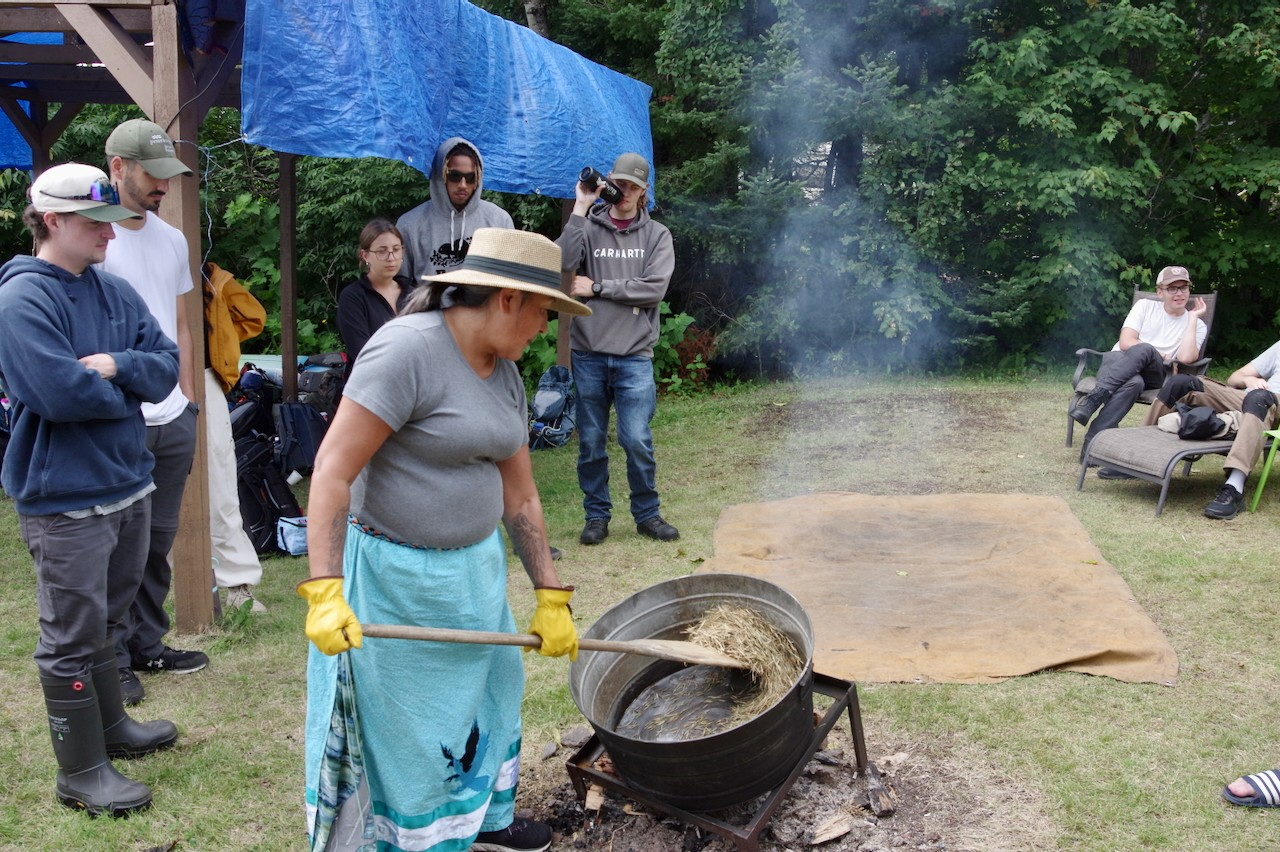
“We’re expecting rain later on, that’s why we’re taking this opportunity to get out there and pick as much as you can,” Lyons says, noting that some of the students were also cleaning some of the manomin while the others were out on the lake. “We’ve got the fire going and the pot is probably ready. We’ve got enough for a couple of pots to show them the (parching) process. The goal is to model it and then they’ll do it on their own, and then when the people come in from the lake, they’re going to be the experts now guiding them what to do, so it’s always this transference of knowledge.”
Lyons says she has been sharing her knowledge about harvesting manomin for about 10 years.
“This is about reclaiming our ways,” Lyons says. “I know that manomin is waiting to be picked. We started this work last year (through a one-year Connection Grant from the Social Sciences and Humanities Research Council) and we found out where manomin grows in northwestern Ontario — we need to get in there and start reseeding and reclaiming this sacred food. This is about food sovereignty, we had this way before the settlers came.”
LeClair says they had 11 canoes out on the lake with students collecting manomin.
“It’s a way of life, a way of being,” LeClair says. “The rice teaches us so much and gives us so much, it’s food, it’s a way of looking at the world, it’s a way of connecting, me and mom from Anishinabek culture connecting with people from all over the world around our love for rice.”
LeClair says they have a special machine that enables them to separate the manomin from the husks.
“Me and my mom like to do some modern approaches to ricing,” LeClair says. “The old way is dancing and cleaning by hand but it’s 2025, so we’re allowed to evolve too.”
Don Jones, a Nigigoonsiminikaaning citizen, says he first harvested manomin on Whitefish Lake with his parents when he was young about 40-50 years ago.
“My parents always harvested this rice around September,” Jones says. “Most of the time we were able to get enough for a winter’s supply, like maybe 20-30 pounds. Different parts of the lake ripens at different times, so we harvest where the rice is ready.”
Brian McLaren, associate professor in natural resources management at Lakehead University, says the water was very shallow in the manomin fields.
“I hear people come from long distances to come here,” McLaren says, noting that some of the students were from China. “So we’ve got students from all over, mostly Ontario, many from southern Ontario. They’re going to appreciate that the land gives and we need to be caretakers because the rice has a certain fluctuation and we’ve heard about flooding. Being gentle with the water and knowing the water is part of the education.”
Zhao, one of the students from China, enjoyed the opportunity to do the parching process with a tub over the fire.
“They’re just putting it in the pot and try to make it hot,” Zhao says. “We took the (canoe) into the lake and used some equipment to get this rice. It’s my first time to experience this … so it’s very fun, it’s very meaningful.”
Evan Robert, an environmental management student, says the manomin teachings were “pretty interesting.”
“I’ve actually spent quite a bit of time on this lake and lakes like this and I honestly had no idea this was happening,” Robert says. “It’s very eye opening and it’s pretty interesting to see something I never knew about and something that happens in an area that I grew up in.”