

Giving our kids the opportunity to carry the narrative
By Marci Becking
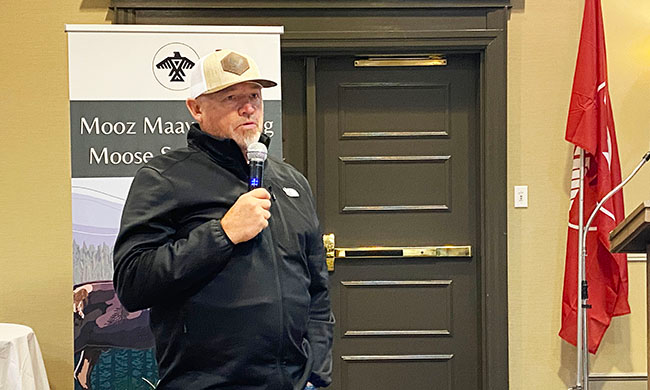
SUDBURY – Unama’ki Institute of Natural Resources Moose Management Coordinator Clifford Paul spoke about the Mi’kmaq concept Msit Mo’kmaq (All My Relations) to some 90 participants gathered in Sudbury, Ont., for day two of the Mooz Maawanjiding held by the Anishinabek Nation from September 3-4.
“It includes past and future generations. Everything that casts a shadow has Spirit. Everything that has Spirit, deserves respect,” explained Paul.
The concept represents a profound worldview where all things in the universe are interconnected. This includes people, plants, animals, land, and the spiritual realm, creating a web of relationships that humans have a responsibility to. The philosophy emphasizes reciprocity, sharing, and a deep spiritual connection, guiding how people interact with the land and each other.
“It’s important that the youth step up and tell us what to do. We take direction from them,” said Paul. “Our Knowledge Keepers are competing with technology…Ensure that our youth are the carriers of the knowledge. They have to be able to carry the narrative. They need more opportunities to learn from the land. Ask yourself: when do the stories end? Who carries the narrative? We have to make sure that our children are part of events.”
Northeast Regional Terrestrial Ecosystem Science Specialist Emilie Kissler from the Ministry of Natural Resources (MNR) spoke about Ontario’s Moose Population Monitoring and the 2025 Moose Aerial Inventory Survey Results.
“Surveys can help to measure effects of regulation and policy changes related to hunting season and tag quotas, population objectives, forest (habitat) management,” explained Kissler. “Moose populations in Ontario have been estimated using standardized plot surveys for decades.”
The population is showing some current stability in the moose population from a previous decline.
Leadership in the room had some questions about Ontario acknowledging the Métis Nation of Ontario and had stern messages for the MNR representatives to take back with them.
“Your influence is giving the Métis Nation of Ontario recognition as rights holders,” said Anishinabek Nation Regional Chief Scott McLeod. “In tag system, the ministry elects to give them false recognition and allows them to make up the rules on their own harvesting. So yes, you do have influence. And you also have influence on First Nations because there’s only a limited amount of moose in our territories. Without consultation, you are basically giving moose to non-Indigenous, non-rights, non-title holders, free will to harvest moose in our territories. Further to that, you are actually giving non-citizens of Canada the same rights to come into our territories without consultation, giving Americans and other people from other countries – because they paid a license to you, which we don’t see any of that money – to harvest our moose on our territories. So, you can’t say you don’t have any influence when you actually do. I totally agree with surveys and a management system that would allow to maintain proper harvesting of animals, but it has to include the title holders of the land, which are our First Nations in our territories.”
Regional Chief McLeod also reminded everyone that inherent rights did not come from a treaty and that we have always had them; it is the settlers who obtained rights from the treaties.
Regional wildlife biologists for the Ministry of Natural Resources, Brad Allison and Kevin Kilgour, gave an overview of the Moose Harvest Planning Process – factors in developing moose harvest and tag quotas.
“Moose Winter Tick induced hair loss – calves are losing 60 per cent of their blood volume when they are in a negative energy balance at the end of winter. What you start to see is that the calves are dropping out of the population first,” said Allison. “Early breeding – how do we get calves bred early? The older bulls are the ones – 5.5 to 9.5 years old that can breed earlier. So, a great strategy is to harvest a younger bull if you have not enough bulls in the population. You’re allowing the older bulls to breed the cows earlier.”
The two-day gathering ended with a sharing circle without government representatives, allowing a safe space for everyone to address harvesting and other concerns for the Anishinabek Nation Lands and Resources staff to consider in future work plans.