

Raising awareness on Fetal Alcohol Spectrum Disorder
By Rick Garrick
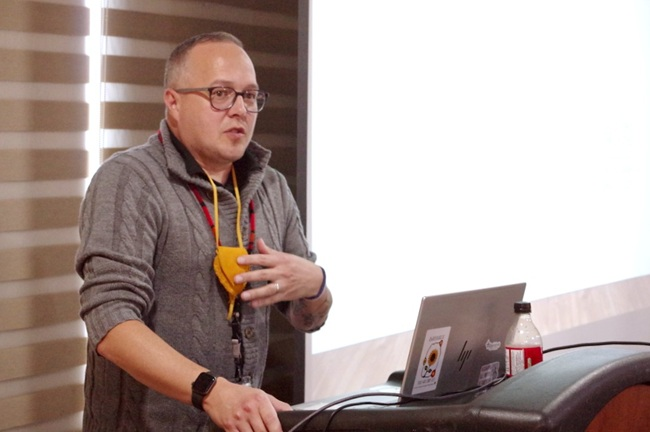
THUNDER BAY — Pays Plat’s Chris Mushquash highlighted how Fetal Alcohol Spectrum Disorder affects people in different ways at the Bewiidookaagejig Northern Superior Regional FASD gathering on Sept. 11 at the Superior Inn in Thunder Bay.
“Alcohol is a very powerful toxic chemical when it comes to brain development and physical development during the prenatal period,” says Mushquash, professor in the Department of Psychology at Lakehead University, Canada Research Chair in Indigenous Mental Health and Addiction and director of the Centre for Rural and Northern Health Research at Lakehead University. “There’s physical, behavioural, cognitive, so intellectual, and mood-related signs and symptoms that may be observed without any real consensus for a typical presentation, and that’s one of the other difficulties with spectrum disorders. Whether it’s Fetal Alcohol Spectrum Disorder (FASD) or Autism Spectrum Disorder, the difference in symptom presentation between people can be massive, like so big that it’s hard to categorize people in the same diagnostic category, but more importantly, really hard to design any types of services that capture the needs of everybody.”
Mushquash says he sometimes does notice differences in presentation between biological males and biological females.
“One of the challenges I often see with that is a lot of young adolescent girls who we work with can read and write at grade level,” Mushquash says. “But socially and emotionally, really don’t have a lot of confidence in navigating relationships or making decisions in their best interests.”
Mushquash says he and his wife are working with a computer scientist to develop a program that would prevent cameras from taking inappropriate pictures of people, addressing the issue of adolescents not being able to make decisions in their best interests when they become involved with people on the internet.
“You can use the camera when you are talking with someone,” Mushquash says. “But if you are being asked to do something inappropriate and you begin to do that, the camera will not work. My goal would be to then put that on the phones of our most vulnerable kids as they are learning to navigate all the complexities of the teenage years.”
Rhonda Konrad, a presenter from Sioux Lookout in northwestern Ontario who delivered a presentation about her son’s life with FASD, says her son Everett gave many gifts to the world.
“Some of his biggest gifts were that he had a life full of love, full of compassion, full of understanding for other people,” Konrad says. “He became a really strong advocate for people who lived with what he lived with in the neurodiversity, and he helped a lot of people on his path that came along with him. He taught teachers, he taught people in government in terms of policies, he spoke at conferences, and he taught the world that people need to accept FASD and people with FASD as people who can bring gifts and strengths and learnings to all of us.”
Chochi Knott, Southeast/Southwest FASD regional worker at Anishinabek Nation, says some of the key aspects of their roles are education, prevention, capacity-building, and advocacy.
“Doing sessions like this brings us together in ways that we’re able to network,” Knott says. “We’re more oral learners as Anishinabek people, so when we come together at these events, we’re able to communicate together and gather and have the medicines present and all empower and make the FASD community stronger.”
Lynda Banning, Northern Superior FASD regional program worker at Anishinabek Nation, also attended the FASD Drum Social on Sept. 9 in Thunder Bay in addition to the Bewiidookaagejig Northern Superior Regional FASD gathering, noting that it’s important to raise awareness about the damaging effect that alcohol can have on a developing fetus.
“It could lead to challenges throughout the individual’s life, so we want to raise awareness and we want to prevent this as best we can,” Banning says. “It’s the first time we’ve tried the drum social and it seems to be going very well; people seem to be enjoying themselves.”
Additional information about FASD is available in the Anishinabek Nation’s Raising Awareness about FASD with Lynda Banning and Chochi Knott podcast that is posted online.