

Details of early learning and child care project provided at Mississauga conference
By Sam Laskaris
MISSISSAUGA – Tammy Cayer-Dokis is rather pleased with how her latest work project is developing.
Cayer-Dokis currently works for Anishinabek Nation, leading the Early Learning and Child Care Quality Improvement Project within the Labour Market Development Department.
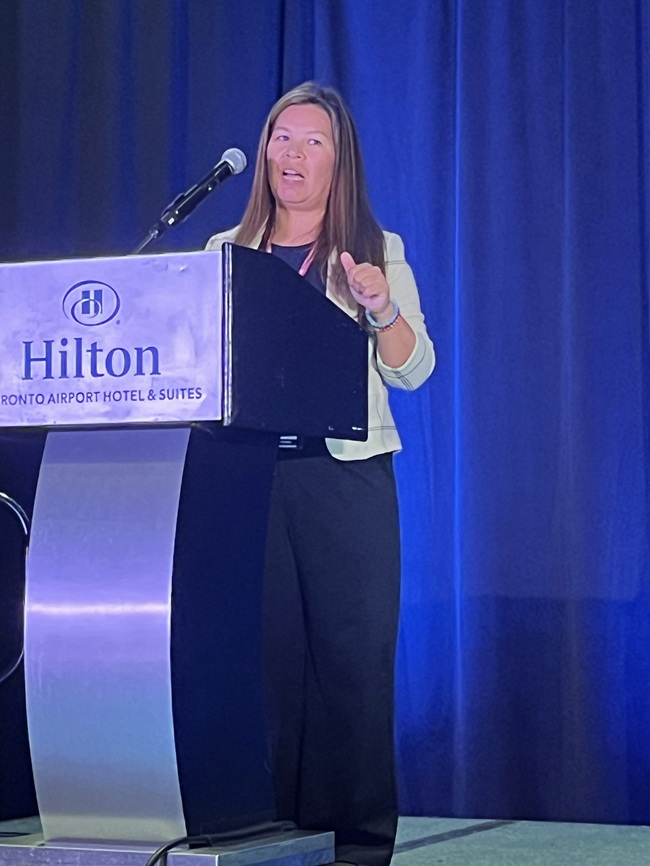
She also attended the recent Chiefs of Ontario Early Learning & Child Care Conference in Mississauga. She provided details of the project that she is spearheading at the event, which was held Oct. 2-3 at the Hilton Toronto Airport Hotel & Suites.
“This is a three-year initiative and this is supporting the 39 First Nation communities across Anishinabek Nation to enhance early learning and child care,” Cayer-Dokis said of her project. “It is becoming or evolving to a co-operative network of educators, leaders, and partners focussed on defining and implementing high-quality care that is rooted in Indigenous knowledges, values, and cultures.”
The first year of the project has been completed.
“For the first year, we focussed on research and learning,” Cayer-Dokis said. “So, we explored best practices that are rooted in Anishinabek values and traditions. And then we also concluded four regional sharing circles, which was our community engagement portion.”
Sharing circles involved those who work at community early learning centres, as well as Knowledge Keepers, to gather stories and insights on what high-quality Indigenous early learning is.
“And now what we have been doing is sharing this knowledge back to communities,” Cayer-Dokis added.
Her conference presentation was also an interactive session. She provided a paper story map, centred on first-year research from the project, to reflect on the themes and consider how these insights can be applied in practice.
Some conference delegates then offered their thoughts of what stood out to them from the story map. One point that was mentioned was that every child is a gift and that children are not only being taught, but they themselves are also teaching educators with their actions.
Cayer-Dokis also talked about the next steps for the quality improvement project.
“We are continuing to offer professional development, but the story map is really enhancing,” she said, adding that the initiative will provide more opportunities for land-based education and learning.
Project representatives are also working on recruitment and retention, as well as a digital resource hub and a new website.
“This will be a hub that will have resources and it will be a network as well to connect 39 First Nations together,” she said.
Plans are also in place to establish an early learning and child care advisory committee, with a goal to become a permanent committee.
“And we’re also looking at community-led evaluation, as well as scaling community success,” Cayer-Dokis said.
She concluded her session by encouraging delegates to be involved with a quality improvement project – either the one she is leading or similar initiatives in communities that are nearby to where the delegates are from.
“This is really about enhancing and improving child care and early learning across our nation,” she said. “The more that we can provide input, the better and more meaningful it will be for our children, communities, and our families.”