

Book review: Sugar Bush Babies: Stories of My Ojibwe Grandmother
 Reviewed by Karl Hele
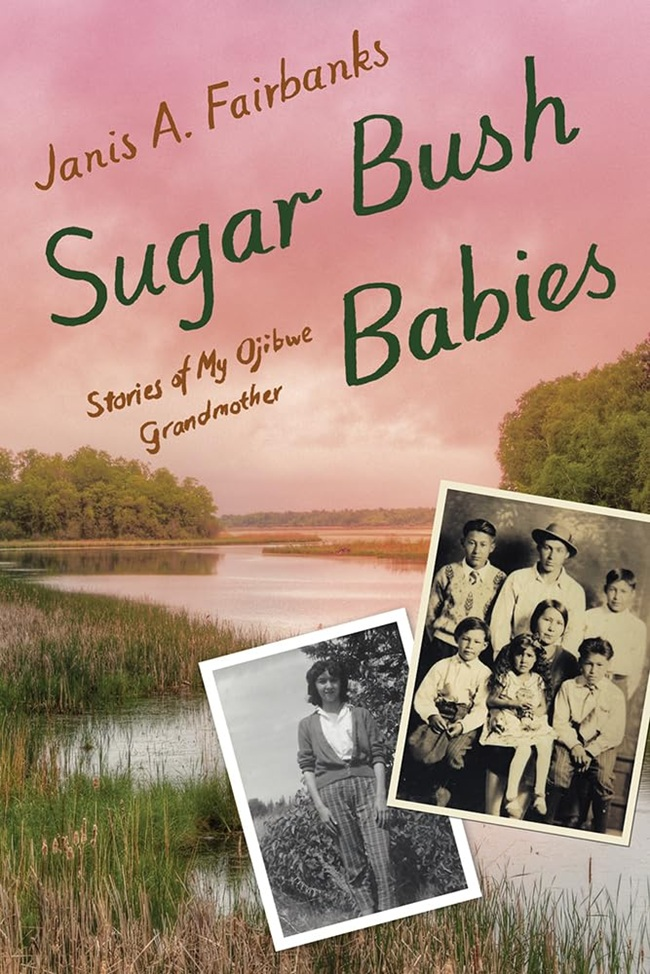
Janis Fairbanks’ Sugar Bush Babies: Stories of My Ojibwe Grandmother is a marvellous account of her childhood, specifically the importance her grandmother played in it. Fairbanks, now a language educator, storyteller, and Elder, attributes spending summers and school vacations at her grandma’s home as the best education. With and through her grandmother, Fairbanks learned to appreciate and observe the world around her, revel in the everyday, be thankful for what you have, and many other lessons. The importance of her childhood – sights, smells, and memories – is recalled and told through engaging and often funny stories. As such, this book is more than a personal narrative or reminiscence; it is a celebration of growing up under the guidance of a wise, kind, and spiritual woman.
Sugar Bush Babies: Stories of My Ojibwe Grandmother is divided into three sections sandwiched between a prologue and an epilogue. The prologue introduces us to Grandma, Nay-ta-baa-ca-co-na-mo-quay or Cecelia Robinson, as well as the importance Fairbanks attributes to her childhood experiences and lessons. The first section, “Bena”, begins with life on the Leech Lake Indian Reservation in Minnesota from 1946 to 1952. Fairbanks speaks of her earliest memories of visiting Grandma and other stories. For instance, Fairbanks recounts failing to learn how to fish and memories of falling off a car’s running board, resulting in a trip to the hospital (17). Importantly, we learn the origins of the title – Cecelia made a dramatic entry into the world at the Sugar Bush (20-22). Section Two, “Duluth,” begins with the family moving into a rented home to seek work and education. She talks about her experiences in the Bowery, an area in Duluth dominated by poverty, where Fairbanks never seems to have felt poor. She discusses efforts to earn money for candy by selling lilacs, the move and life on 8th Street, family pets, school, visits from Grandma, her one year with the Girl Scouts, being on the honour roll, and a trip to the circus. This section, while focussing on pleasant memories and experiences, Fairbanks was the happiest during Grandma’s visits and trips back to Bena. The final section, “Fond du Lac” is the best section of the book. You can tell from the stories and the writing that this is where Fairbanks was the happiest—working and playing with Grandma, visiting with ‘old ladies’, dancing at pow wows, and simply learning. Fairbanks worked hard or was always busy, but with fun and joy always present. Simply, “Grandma was a good one for learning lessons from, whether you were trying to learn or not. Things just happened that left an impression on you if you were lucky enough to spend time with her”(99). The epilogue is a mere four pages, bringing Fairbanks front and centre as a person who is now a grandmother and teacher, following in the footsteps of her grandmother and all the grandmothers before her.
Sugar Bush Babies: Stories of My Ojibwe Grandmother is absolutely wonderful. It is a testament to strong Anishinaabe women and the power they wield in teaching the next generations. The book is a well-crafted celebration of the importance of Cecelia’s outstanding impact on Fairbanks’ life. I highly recommend this work. It is more than a testament to Cecelia; it is full of life and cultural lessons subtly told, as well as a window into growing up Anishinaabe in the late 1940s through the 1950s. As such, the book will have a wide appeal from middle school through university, as well as anyone interested in a wonderful personal story.
Janis A. Fairbanks, Sugar Bush Babies: Stories of My Ojibwe Grandmother. Minneapolis: University of Minnesota Press, 2025.
ISBN: 978-1517919023