

Anishinaabe artists featured at the Aanikoobijiganag: Thunder Bay Beading Symposium
By Rick Garrick
THUNDER BAY — M’Chigeeng First Nation’s Anong Migwans Beam and Netmizaaggamig Nishnaabeg’s Melissa Twance were among the artists featured at the Aanikoobijiganag: Thunder Bay Beading Symposium 2025, presented by the Thunder Bay Art Gallery on Oct. 15-18.
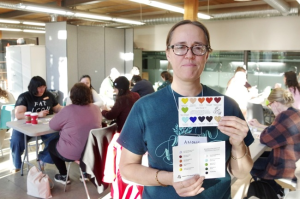
Beam delivered her Tisgeh’dah! Let’s Put Colour On It! Watercolour for Designers workshop on the second day of the symposium.
“It was a watercolour workshop just introducing them to painting as a different medium, recognizing that they are already creative professionals,” Beam says. “I’m just trying to show them watercolour as maybe a way to think about planning a design or practising and moving colour in a different way because beadwork is so exacting and precise and watercolour can let you try colours in a more speedy way.”
Beam says they did some basics on different kinds of brushes and approaches to watercolour.
“One of the great things about watercolour is it’s portable, you can easily take it outside or on a boat or on a mountain, wherever you happen to be going and pull out a whole range of colours and put it back in your pocket,” Beam says.
Beam also shared some of her Beam Travel Cards featuring concentrated and dried watercolour paints with the workshop participants.
“When you add water, it activates, and it’s really portable,” Beam says. “One of those cards, that could last somebody years. I actually very rarely ever see them fully used up. We sell them online at beampaints.com, and the Thunder Bay Art Gallery supports us by selling our paints in their gift shop.”
Beam says her father, Carl Beam, used to make his own paint.
“It was a private part of his practice he never really brought out in a public way,” Beam says. “But it was really fun for me to rediscover with my own family and it grew into the business.”
Twance, one of the co-directors of the symposium who participated in the Artist Panel: Thinking is Doing is Dreaming on the second day of the symposium, says the symposium was a great opportunity to network.
“We had Jordyn Hrenyk, we had Lisa Myers, we had Judy Anderson, and we had Marcy Friesen on the panel, as well as myself, and we got a chance to talk about beads as a process and how working with this particular material opens up new ways of knowing for us,” Twance says. “It was a really great conversation.”
Twance also co-curated the Aanikoobidoon II art exhibition, which featured 15 Indigenous artists from Ontario, Alberta, Saskatchewan, and Manitoba, at the Co.Lab gallery on the third day of the symposium.
“A lot of them work with beads, so beadwork artists, we also have a lot of people who work with different mediums like birch bark and we also have someone who does wood carvings,” Twance says. “We made sure to include emerging artists alongside some more established ones. We have Amber Sandy and Katie Longboat and Cher Chapman and Helen Pelletier as part of the show, but we also have some lesser known folks like Sara Gilbert and Belmo and Zoey Therriault — being able to showcase some of those younger artists alongside these more established artists is really great for them because it’s important for them to see that their work is worthy and valuable and everyone wants to see it.”
Fort William First Nation Chief Michele Solomon says the Aanikoobidoon II art exhibition included three artists from Fort William, Chapman, Pelletier, and Sheila Demerah.
“I appreciate being able to come out and acknowledge their artwork and their contributions to this art show,” Chief Solomon says. “This happened aligned with the beading symposium last year as well, so I think it’s a great way to end off the symposium, for vendors to come and showcase some of their pieces and, of course, these special pieces that are in the art show.”