

Learning respect for animals and teachings through quillwork
By Rick Garrick
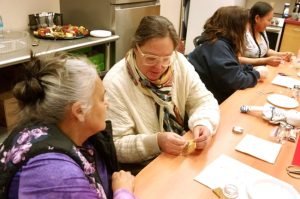
FORT WILLIAM FIRST NATION — A group of participants enjoyed learning how to work with porcupine quills during Fort William’s Quilling Technique Workshop with Jean Marshall, held Jan. 14 at Fort William’s Social Service office. Marshall, a Kitchenuhmaykoosib Inninuwug citizen who lives in Fort William First Nation, shared her quill preparation and zigzag technique with the participants during the three-hour evening workshop.
“I found it very informative, very well done,” says Fort William Elder Sheila DeCorte, one of the workshop participants. “Jean is a good teacher, she’s very talented and has a lot of skill to offer us, and I’m really appreciative that she’s able to come and share her teachings and her experience with us.”
Elder DeCorte says she plans to continue doing some quillwork at home after the workshop.
“I kind of enjoy it right now, I’ll see to what extent I go, but I’m definitely going to finish something,” Elder DeCorte says. “I’m going to make a little pouch, a medicine pouch, with that once I’m finished.”
Elder DeCorte says she also enjoyed learning the zigzag technique using a ribbon instead of a quill to get used to the technique.
“I like this technique with the ribbon too because I think I’m going to try doing that on a ribbon skirt,” Elder DeCorte says. “I like that with the ribbon.”
Erin Bottle, a Mishkeegogamang citizen who brought her four-month-old daughter with her to the workshop, says quilling was a very relaxing craft to learn.
“I think we need more quill workshops in the territories,” Bottle says. “It definitely gives you more respect for the animal, for the quills, and the passing of knowledge.”
Bottle adds that she appreciated learning how to do the zigzag technique.
“It was pretty fast for me, I think a lot of it was more of listening to the quill before tacking it,” Bottle says, noting that she made a couple of errors in the beginning. “I’m going to keep doing it, I’m definitely going to learn more techniques on it.”
Marshall says the participants learned how to sew porcupine quills onto moose hide during the workshop.
“They all left with an understanding and newfound respect for this natural material,” Marshall says. “One of the things that I shared with the participants about the material is that it’s a pre-contact material, it’s a material we used before … all the colourful glass beads came. Working with the quills is actually, in my mind, the traditional art form for us.”
Marshall says she was happy to share the knowledge she has about quillwork with the participants.
“And I hope to see more quillwork in our community,” Marshall says.
Marshall says the workshop was like a sewing circle where the participants could visit and talk with each other while learning how to do the quillwork.
“This is a place where we can all come together and feel a sense of belonging,” Marshall says.
Marshall kicked off the workshop by stressing the importance of cleaning porcupine quills with dish soap before using them, noting that she does a clean sort when pulling the quills off a porcupine so they are all sorted according to length.
“The porcupine has 30,000 quills on it,” Marshall says. “The tail quills are short and thick, and those quills would be used for making chokers or jewellery; they’re, like, more cylindrical.”
Marshall says she usually collects porcupine guard hairs for men to use for their roaches for their pow wow regalia.
“You pull all the guard hairs out first,” Marshall says, noting that it is her technique for removing the quills. “You clean all the hair off of it, then you can access the porcupine quills.”