

HART Hubs supporting community safety and addiction recovery across First Nations
February 2, 2026
By Leslie Knibbs
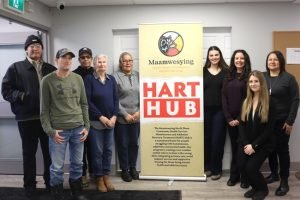
SAULT STE. MARIE, ON – With the recent press release on January 15 from the Ministry of Health, the Honourable Greg Rickford of Indigenous Affairs and First Nations Economic Reconciliation announced the expansion of access for those requiring high-quality mental health programming and Addiction Recovery Treatment. Included in the expansion is the new Indigenous-led Homelessness and Addiction Recovery Treatment (HART) Hub, operated by Maamwesying North Shore Community Health Services in Sault Ste. Marie, Blind River, and Sagamok Anishnawbek.
The HART Hubs will enable people to access a range of comprehensive treatment and recovery services, such as primary care, mental health services, addictions care, social services, and employment support. The Hub will operate from three locations in partnership with Maamwesying North Shore Community Health Services in the Sault Ste. Marie area, as well as Blind River and Sagamok Anishnawabek.
“All communities in the North Shore Tribal Council are committed to this HART Hub that will help our families struggling with the opioid epidemic, building bridges between silos,” recently stated Carol Eshkakogan, Chief Executive Officer with Maamwesying North Shore Community Health Services. “This will support an established and trusted network to integrate care for our people both on and off-reserve. Thank you to Premier Ford for continuing to recognize the leadership of Maamwesying and the importance of investing in Indigenous services as a recovery pathway.”
Eshkakogan made it abundantly clear the importance and significance of the HART project.
“This project is a milestone for Indigenous health and well-being,” she said. “By bringing care directly to Indigenous communities rather than requiring individuals to seek it out. With a ‘no door is the wrong door’ approach, the HART hub will coordinate to deliver comprehensive support, bridging gaps in existing services and fostering collaboration among Indigenous services.”
Allan Moffatt, Chief Executive Officer, Mamaweswen, The North Shore Tribal Council followed this saying, “Yesterday, January 15, 2026, we were honoured to come together for a grand opening gathering to mark an important milestone for the Maamwesying Homelessness and Addiction Recovery Treatment (HART) Hub…This gathering was a time to reflect on the vision for the HART Hub, to honour the relationships that have brought this work forward, and to acknowledge the collective effort underway to build an Indigenous-led, culturally grounded approach to care and recovery for our communities.”
“This HART Hub is designed as an Indigenous-led, holistic model of care—where traditional Anishinaabe knowledge stands alongside health care, mental health supports, housing, and social services, in a way that respects people and meets them where they are,” said Peyton Pitawanakwat-Ominika, Chairperson, Maamwesying NSCHS Board of Directors.”
“The North Shore Community Health Services (MNSCHS) falls under the leadership of Mamaweswen, the North Shore Tribal Council, an Indigenous Primary Health Care Organization (IPHCO) that provides comprehensive, culturally-based primary health care services in collaboration with the communities of Atikameksheng Anishnawbek, Sagamok Anishnawbek, Serpent River First Nation, Mississauga First Nation, Thessalon First Nation, Garden River First Nation, Batchewana First Nation, as well as the Indigenous Friendship Centre in Sault Ste. Marie, for over 30 years. In 2011, MNSCHS expanded services to our urban Indigenous population in Sault Ste. Marie and the surrounding area by establishing the Baawaating Family Health Team. In 2018, MNSCHS created our Northern Clinic, facilitating the expansion of primary health care services to the communities of Michipicoten First Nation, Chapleau Cree First Nation, Chapleau Ojibwe First Nation, and Brunswick House First Nation. Our geography spans over 620 kilometres, including 12 healthcare center sites located within our respective communities.”
The Kenora Chiefs Advisory out of Kenora are pleased to announce that “the existing Kenora Emergency Shelter and Clinical Services Hub will be enhanced by including the HART Hub expanding its capacity “to offer a seamless continuum of care that integrates cultural practices and traditional healing methods. This model emphasizes cultural safety, ensuring that services are delivered in ways that respect and incorporate Indigenous knowledge, practices, and community values. This Hub focuses on the delivery of a culturally responsive care model, tailored to the needs of Indigenous individuals, who are over-represented in homelessness and addictions statistics.”