

Community farm and pet treats business among panellists at First Nations Agricultural & Finance Ontario Conference
By Sam Laskaris
CHIPPEWAS OF RAMA FIRST NATION – It’s not all about the money.
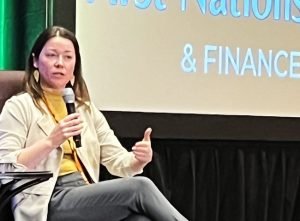
That’s a message that Kailey LeDrew, the manager of the Rama Community Farm, stressed during her presentation at the First Nations Agricultural & Finance Ontario Conference.
The three-day event, which concluded Feb. 5, was held in Chippewas of Rama First Nation. LeDrew was one of three panellists at a conference session titled Communities in Agriculture.
LeDrew, who is heading into her sixth season of managing the Rama farm, explained how it is owned and operated by Chippewas of Rama First Nation. All those who work at the farm are members of the First Nation.
“Food sovereignty and growing as much food as possible was a big, significant goal,” LeDrew said of the initial vision of the farm. “Essentially, Chief and Council had run a community visioning program and they noticed the lack of produce in the area. They put the money in and they were really, really prepared to answer the community’s call for this…And it was a big dive-in project growing a ton of food. I think there were conversations with community about what it is that they wanted to eat. And there were all of these ideas that everyone would show up and everyone would help farm and everyone would get involved.”
LeDrew said running the farm is not an easy task.
“I think small farming falls victim to romanticism a lot,” she said. “People think they’re going to kind of be skipping through fields with wicker baskets and butterflies. And it’s hard work.”
LeDrew said the success of other Chippewas of Rama First Nation businesses is what allows the farm to keep operating.
“It would be cheaper for us to buy food for everyone in Rama than it is to run the farm,” she said. “But we lose out on that long-term investment in our community, in our kids, and what we’re able to offer, that we wouldn’t be able to offer if we just purchased everything for everyone.”
What Chippewas of Rama First Nation representatives are able to offer is a place for community members to gain valuable skills, which can be transferred to other positions later on.
“I don’t want to say we don’t think about money at all anymore,” LeDrew said. “But once we shifted to realizing that our success is going to lay in the support and the skills that we build within our own community members, that’s when we actually saw the production of our vegetables go up.”
LeDrew said the farm’s 2025 season was a big hit.
“We just had our most successful year this year,” she said. “And I think it was the biggest year that we’ve really put into focusing on the people. But then also what’s happened is that the different departments within Rama are now taking more notice of us. And they are reaching out to us and wanting to see how they can get involved in the farm, how they can run programs at the farm, how we can get our produce into their departments to distribute among the community.”
The panel also included Keri Gray, a member of Algonquins of Pikwàkanagàn First Nation, who owns Shades of Gray Indigenous Pet Treats.
Before focusing exclusively on her pet treats business, Gray also owned a meat business. But six months after launching her current company, she sold that to concentrate on the one business.
Gray said she’s kept rather busy staying on top of “trends, safety regulations, licensing, all the things that go with manufacturing and producing a product.”
And she’s rather content with the business she has now.
“That’s a real rewarding thing for me to do and look after and feel confident in the product that I could sell to pet parents,” she said. “For me, that’s a real reward. But I think I also really enjoy finding funding. I really enjoy the opportunities that comes with that funding.”
Gray also had a parting message during her presentation.
“My takeaway that I’d like to leave here today with everyone is that strong, agricultural businesses come from global knowledge,” she said. “They come from long-term thinking … and respect for the land, the people, and the processes that we undertake in our communities when we’re doing our businesses.”
The Communities in Agriculture session also included Cheryl Lambert, a member of Flying Dust First Nation in Saskatchewan.
Lambert, a long-time entrepreneur, has operated more than 20 businesses. Her current company, In Fine Feather, is a Burlington-based modern mercantile and market garden.