

Anishinabek economic development leaders featured at 3rd Annual Northern Economic Development Gathering
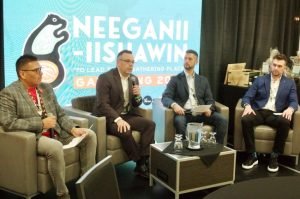
By Rick Garrick
THUNDER BAY — Anishinabek Nation Northern Superior Regional Chief Melvin Hardy, Red Rock Indian Band’s Jason Thompson, and Biigtigong Nishnaabeg’s Vincent Nabigon were among the featured presenters at the Neeganii-Iishawin 3rd Annual Northern Economic Development Gathering.
Held Feb. 10-12 in Thunder Bay, the gathering was hosted by five tribal council partners that represent 34 First Nations across northwestern Ontario, including Matawa First Nations, of which Long Lake #58 is a member.
“This was a good opportunity to network and connect with the proponents that can actually work with the First Nations — I spoke to many of them today, and I found that they were right cued into ensuring the engagement that they do with us is very wholesome,” Regional Chief Hardy says. “What I find too is that they will take their time to explain their projects to them and the work they can do, and they are willing to go even farther than that by adopting some of our ways within their processes. And from a First Nation lens, I think that’s something we really need to be able to understand, but we also need to develop relationships with these proponents because this is the only way we are going to be able to move ahead.”
Regional Chief Hardy also stressed how First Nations have found their homelands targeted by both levels of government over the past year during his opening remarks on the first morning of the gathering.
“Canada and Ontario have both passed legislation that have made us all take a step back and strategize on how we move ahead,” Regional Chief Hardy says. “We find ourselves in great uncertainty with the changing times and as well with the current geopolitical climate, both to the south of us and across the Minnesota line and overseas. Despite the uncertainty, we all remain certain that there will be no development without us.”
Regional Chief Hardy also highlighted the importance for First Nations to stand together.
“When we’re united, we’re stronger, and we have the ability to influence in many ways that are strategic and the ways that will honour our sacred responsibilities and bring prosperity to our communities, something of which is long overdue,” Regional Chief Hardy says. “Today is very important to build continuing relationships so that we all remain united across Ontario as we face the challenges of these changing times as well as economic uncertainty.”
Thompson, president and CEO at Superior Strategies and Warrior Engineering, says the gathering was very inspirational.
“It’s been very inspirational hearing a lot of stories about what is going on and hearing what other nations are doing, entrepreneurs are doing, it’s been tremendous, and a lot of talk around collaboration and working together, it’s fantastic,” Thompson says.
Thompson led the First Nation Business Showcase panel, which included Nabigon, CEO at Biigtigong Dbenjgan, on the final day of the gathering.
“We had three different [economic development] corps presenting on their successes, challenges, and where they are today,” Thompson says. “So it was inspiring.”
Nabigon stressed the challenges that First Nations face when developing businesses.
“There are a lot of challenges in these businesses that we look to start to create generational opportunities and opportunities to create growth to work towards having communities be self-reliant,” Nabigon says. “So I think a part of that is where there are gaps, don’t be afraid to obviously use your partnerships that you have and to reach out to anybody that you can, even doing nation-to-nation discussions on whether or not you can get help in these opportunities.”
Nabigon also highlighted how Biigtigong Dbenjgan started up an industrial laundry facility to serve industries in the region.
“We do coveralls and mats to support our region and within our traditional territory,” Nabigon says. “There’s around nine or 10 mines within a 400-kilometre radius and a lot of mines and other projects are going 300 to 500 to 800 kilometres away [for] a service that we can do within our territory and, of course, outside our territory in our region.”
Nabigon says they pick up the coveralls and mats from the facilities for cleaning.
“As First Nations people in our community, we pride ourselves in providing a first-rate service and representing our community appropriately,” Nabigon says. “We want to have the best service that suits the customer.”