
Author’s inner superhero shines in The Unbeatable Sonya Ballantyne
By Kelly Anne Smith
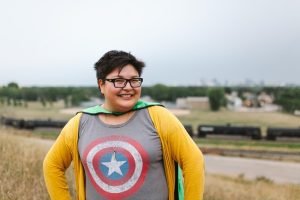
ROSEAU RIVER ANISHINABE FIRST NATION – Sonya Ballantyne is Superman and talks to kids about their own superpower and her new graphic novel, The Unbeatable Sonya Ballantyne.
Sonya knows good thoughts triumph.
Ballantyne is a writer and a filmmaker from Misipawistik First Nation. Misipawistik means rushing rapids, from time before the Manitoba Hydroelectric Dam. As a young child, she decided she was a descendant of a great people and was destined for big things, but had to grow up. Superman didn’t know his powers either when he was young, so that helped her put up with the unjust parts of her life sometimes, she says.
“It helped me in such a good way and really developed my code of honour and my ethics. I’m really thankful for that. I can never be Superman but I’m always eternally striving to be like him.”
The author is having a really good day visiting students at Ginew School in Roseau River Anishinabe First Nation in Manitoba. Sonya interjects lighthearted humour and imagination in her talks about serious topics such as racism.
“One of my friends is from here, so I was visiting the school to talk about writing and stuff. It was such a fun day.”
As she tucked fresh fried bannock from her friend into her backpack, Sonya says today’s talk was for students mostly under Grade 8.
“Elementary is so much more fun because the kids are more into my superhero side—they are more willing to go along with that idea of daydreaming, that role-playing aspect; whereas teens are a bit more jaded, so I have to be a bit more realistic with my talks there. The kids just love talking like, ‘Oh, yeah! Superman and Batman, hooray!’ I just love doing that, too.”
Reading Sonya’s youth story, The Unbeatable Sonya Ballantyne, gives kids a confidence boost.
“I spent so much of my childhood waiting for somebody to save me. I didn’t really go hardcore into my relationship with my parents (in the graphic novel), but it wasn’t the best. I do mention it with my mother. I was constantly waiting for somebody to save me. And when I grew up, I realized that person was me. I basically became the person that I needed when I was a kid because that person is still needed,” recounted Ballantyne. “I’m trying to ensure that [the] loneliness that I felt through that inability to fit in is something I stress to kids. Especially, I was terrible at school as well. When I talk to kids now, people always think that because I’m a writer, I must have been really, really good at school. I’m like, no, I barely graduated high school, though I was the first person in my family to do so. It still was an adventure to get there. I’m always trying to make sure that all the kids know there was nothing special about me until I decided there was. I was just an average rez kid growing up with parents that probably shouldn’t have been parents.”
Sonya Ballantyne has a keen memory for movie scenes, comparing seeing her book for the first time to one in the Winona Ryder version of Little Women.
“There’s a scene at the end. Jo Marsh has spent all this time trying to get something written, and when she finally writes something from the heart, that’s when it gets published. That’s basically how I was. ‘Oh, my god! It’s my book!’ But it was also overwhelming, too, because of the first time Rheal (McGregor) sent me the concept art for how she was going to do the characters in the book, specifically my grandparents. It was a little emotionally overwhelming because my grandparents died when I was 18. And seeing them like that was so overwhelming in a good way because it was like they were alive again to me. And so, it was the same thing for the book. One of my favourite things about doing interviews for the book right now is people keep asking about my grandmother. Being able to talk about her again feels like she’s still alive. It feels good in that way.”
The writer uses humour in scenes with her Grandmother who was fiercely protective of her.
“I was so worried when I was writing her because I didn’t want her to come off as antagonistic. Where her over-protectiveness came from was because my Grandma was forcibly relocated from her home community due to a massive man-made flood. And so, she didn’t have the easiest life. Her over-protectiveness was how she showed she loved you; ‘I don’t want you to go through what I’ve had. I’m going to make sure you don’t.’ She also operated internally under the assumption that I was 10 years younger than I was. She’s not letting me go on escalators when I’m 15. That sort of thing.”
Ballantyne explains that Sonya’s grandparents called her Stitum.
“Stitum is like a really shortened slang version of the Cree word nosisim, which means my grandchild. And it wasn’t until I was older that I found out that stitum means. It means my most precious grandchild. The reason that was such a big deal was because I wasn’t allowed to speak Cree when I was a kid. My Grandmother insisted on it even though my parents and my grandparents were fluent. I’m not exactly sure why. Probably due to colonization.”
Pop culture was the great escape for Sonya’s young self.
“The reason I got so into pop culture because everything my parents told me about the world was wrong, according to these superheroes I love. People were inherently kind. People are inherently trying to do good in the world. And it went totally against my experiences as an Indigenous person. Because the first racist thing I ever encountered, I was like three. The first sexist thing I encountered I was probably like four.”
Sonya Ballantyne passes down her wisdom to her younger self and other youth.
“We have no way of knowing what other people are going through in their experiences. We have no way of knowing if our experiences are similar to anybody else’s. You can’t truly know what other people are thinking, feeling, or experiencing. And that can be really lonely. One of my favourite books, and is actually what inspired the cover of The Unbeatable Sonya Ballantyne, is the book Matilda and the movie. I think every lonely kid with parents that they didn’t get along with related to Matilda. She loved books for the same reason I did. And it was that message you’re not alone. That was basically why I wrote this book. For the loneliest part of my life, when I was a teenager.”
Sonya says everybody feels weird growing through their teenage years.
“Even the most popular people are going through stuff and driving themselves nuts. Whatever gets you through life, even if it’s just like a fictional superhero. Even if it’s just a book. Even if it’s an album. If it’s a band. Whatever gets you through, as long as it’s not hurting you or others, is what matters. Then I guess that’s the point of the book. All of this stuff created a perfect ecosystem in which I could thrive. And even though it was difficult and I wanted to give up a lot of the times, like, even if you give up, the world keeps going. So, you might as well keep going. No matter what, time’s going to pass. And you can use that to your advantage.”
Sonya says she wrote the book remembering life events as if she were Superman.
“I do include some dark stuff, like when I got attacked by those boys on the bus and behind the stage and stuff like that. But it was something I wanted to ensure was in there. This is stuff people are going through even right now. I just want to make sure they know and see that.”