

Distinguished Anishinaabe researcher talks adverse childhood experiences
By Rick Garrick
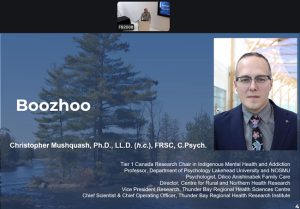
THUNDER BAY — Pays Plat’s Chris Mushquash highlighted how adverse childhood experiences (ACEs) are increasing among First Nations people during Lakehead University’s Distinguished Researcher Talk: Community-led Indigenous Mental Health and Addiction Research on Feb. 26. Mushquash, professor in the Department of Psychology at Lakehead University and the Northern Ontario School of Medicine University, clinical psychologist at Dilico Anishinabek Family Care, vice president research at the Thunder Bay Regional Health Sciences Centre, chief scientist and chief operating officer at the Thunder Bay Regional Health Research Institute, director of the Centre for Rural and Northern Health Research at Lakehead University and Tier 1 Canada Research Chair in Indigenous Mental Health and Addiction, delivered his presentation at the CASES Building Atrium on the Thunder Bay campus as part of Lakehead University’s Research and Innovation Week.
“We published this paper a couple of years ago now — in general, adverse childhood experiences in the general population are going down, and they should be,” Mushquash says. “As we progress in society, the amount of adversity a child experiences before the age of 18 should be decreasing. In First Nations, it’s increasing. Now here’s the challenge, currently, there’s insufficient systems and services and supports for people who have experienced these things. And the rates of adversity are increasing, so if you think there’s not enough service now, wait 10 years.”
Mushquash also stressed how adverse childhood experiences affect people during his presentation.
“Adverse childhood experiences disrupt typical development in a number of different ways, not the least of which is prefrontal cortical development, which is the home of your executive function, and that’s an attachment-mediated process, so biological attachment through infancy and early childhood,” Mushquash says. “Once that’s disrupted sufficiently, you end up having some difficulties in areas like emotion regulation, impulse control, planning, organization, self-monitoring. Depending upon the model, there’s somewhere between 11 and 14 agreed upon executive functions, very important functions as you can imagine, to sort of be well.”
Mushquash says the first thing people tend to do when they look at ACEs literature is to apply it to themselves or to people they know.
“So they’ll say, ‘Wow, I have one, two, three of those, am I doomed?’,” Mushquash says. “Well, the answer is no. You can’t use population-level data to predict individual outcomes. At the individual level, all bets are off. You probably know someone, or you might be somebody who has experienced a tremendous amount of childhood adversity, but you’re sitting in university right now, and you’ve managed to organize your life such that you’re listening to me talk. So always resist the urge to apply population-level data to the individual.”
Mushquash says in a study they did at Dilico Anishinabek Family Care, which is forthcoming, they looked at building ACE measurement into general child welfare practices as a means of trying to predict future need at the population level.
“If I know ACEs increase risks and I know the mean ACEs in the group of people that I am looking to predict what might be needed in the future, then I can presumably model the health and human resource needs, the housing needs and so on,” Mushquash says, noting that it baffles him why data is not used for decision-making about future capacity needs. “So what we’re trying to do is make the case that these data should be used for decision-making now to produce system capacity when you need it, not to be scrambling.”