

Laurentian University excelling in Indigenous research
By Rick Garrick
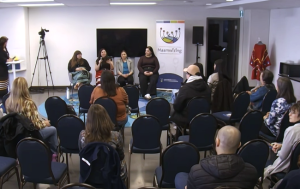
SUDBURY — A group of Indigenous researchers shared their research during Laurentian University’s Weaving Knowledges: Indigenous Research Excellence at Laurentian University session that was open to the community on March 23 at the Parker Building.
Wiikwemkoong Unceded Territory’s Amanda Wassegijig-Trudeau, graduate student, PhD Rural and Northern Health at Laurentian, says the objectives of her research were to determine if there are enough supports for mothers who are birthing and whether they are sustainable during her Re-Igniting the Matriarch and First Nations Childbearing Practices presentation.
“I want to look at how to bring birth back to community, but also how to keep the connection to community when mothers do have to travel,” Wassegijig-Trudeau says. “My question [is], what factors improve birthing experiences for First Nation mothers and their families who travel to urban medical settings? So I want to identify resources, services, and supports.”
Wassegijig-Trudeau says her framework is a two-eyed seeing framework, which was first introduced by Elders Albert and Murdena Marshall in 2004.
“It talks about using both eyes to understand and make sense of the world,” Wassegijig-Trudeau says. “So one eye, you’re looking at Indigenous ways of knowing and doing, the other eye, you’re looking at Western ways of knowing and doing; however, you need both eyes to identify strengths and how these two can work together.”
During her Status Quo Shouldn’t Be Your Legacy: Knowledge Keeping, Lived Experiences and Treaty Education presentation, Long Lake #58’s Keri Cheechoo, associate professor, School of Indigenous Relations at Laurentian, says her research question was, how do we ensure young people are familiar with their ancestral lands and become treaty experts, passing on these knowledges and histories of the relations past, present, and future?
“When we think about it, I don’t know if you’ve thought about it, but I always think about it, but stories are alive, they breathe through survivors travelling, whispering the old stories for new generations to learn,” Cheechoo says. “So ultimately, I’ve been approached by an Elder who is also a Knowledge Keeper who is seeking to engage relationality, and reciprocity in a good way — they are a survivor of the Indian Residential School System and he has spent his life speaking truth to power and teaching about Indigenous governance through his Mushkegowuk lens. He has asked me to collect stories around knowledge keeping, lived experiences, and treaty education of his ancestors and relations and to transmit these narratives to the next generations in a variety of modalities.”
Henvey Inlet’s Ophelia O’Donnell, graduate student, PhD Rural and Northern Health at Laurentian, says her research looking into the health experiences of Indigenous women came from her mother and her experiences as an Anishinaabekwe with rheumatoid arthritis navigating the healthcare system during her Anishinaabe Kweok Conception of Health presentation.
“So then I came to this idea, we’re accessing healthcare under a paradigm or understanding of health that is not aligned with who we are and what health means to us,” O’Donnell says. “The purpose of this research was to understand what it means to be healthy and unhealthy, to be in a state of health and un-health as an Anishinaabekwe, to share stories of experience and to listen to the dreams and future of health care access, and most importantly, to provide a space for Kweok to share their stories and provide solutions to improve the health experiences of Anishinaabekweok.”
Wiikwemkoong’s Alicia Williamson, assistant professor, School of Indigenous Relations at Laurentian, says she is still early in her PhD journey and has not finalized her research, noting that her research starts with the matriarchs on her maternal side and her family’s quillwork practices during her Ethics of Care – Resurgent Research Journey Encounters presentation.
“Making was always a part of my childhood — this is a very grounded art form, and my grandmother and my great grandmother both had very extensive quillwork practices, they were pros. They were making quill boxes to sustain their families, they were making together with their sisters, with my great aunties, and that was a part of their life,” says Williamson, who shared a collage with a photo of her grandmother and some of the stencils that her family used in their quillwork. “I’m at this stage where I’ve been contemplating very specifically what is research for? Who is it for? And what can a research journey provide to me to take time to focus energy on this knowledge bundle that the matriarchs in my family spent so much time and care holding on to and laying down for me and my relatives to pick back up now?”
Moose Cree’s Isabelle Innes, graduate student, Master of Indigenous Relations at Laurentian, also delivered a presentation on Healing in Child and Family Services of Northern Communities during the session, which was held as part of Laurentian’s Research Week 2026 that ran from March 23-27.
“This event was really important because it highlighted Indigenous research that’s happening at Laurentian, and I think, personally, it’s important that we lift up specifically Indigenous graduate students as they’re going through their different stages of their research process,” Williamson says. “The event was a great success — I think this event really brought in a broader crowd to consider the work that Indigenous researchers are doing at Laurentian.”