

Zhiibaahaasing shares cultural teachings with community
By Rick Garrick
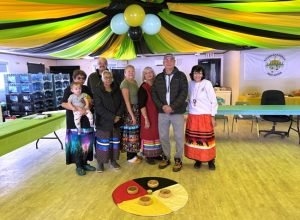
ZHIBAAHAASING — Wiikwemkoong Unceded Territory Nokomis Martina Osawamick and Sagamok Anishnawbek Councillor Leroy Bennett shared teachings during the Zhiibaahaasing Cultural Speaker Series Stages of Life and Ceremonies session on March 23 at the Zhiibaahaasing Complex.
“I used my four-coloured cloth on the floor and I had medicines around there and a candle,” Nokomis Osawamick says. “Starting from the east, I had the colour of yellow, and I talked about the good life and traditionally how we raised our children to the best way.”
Nokomis Osawamick says she shared some cultural stories as well as her own personal stories as a grandmother, including about the placenta, umbilical cord, tikinagan, moss bag, Walking Out Ceremony, and Naming Ceremony.
“I shared a lot of personal stories of my own grandchildren as they were little ones, about receiving their name, their clan, and that kind of celebration when they were small,” Nokomis Osawamick says. “So, a lot of that was traditional teachings.”
Nokomis Osawamick says she used the Medicine Wheel to talk about the seven stages of life.
“I talked about the importance of bringing our children in that good way,” she says. “I shared about the raising of my children to have that good life, emphasizing that education is important. I talked about my family and I related lots of personal ways of how a person goes through those seven stages.”
Nokomis Osawamick says she also shared how her grandson has become an avid hunter.
“He brought all these partridges to me, and I said, ‘Hey, we’re going to have a ceremony, go tell your mom,’” Osawamick says. “So I made partridge stew, and this is uplifting the young lad. When he was about 13, he went with his mom and stepdad to go hunting moose and he shot his first moose. And again, we had a big family ceremony just to uplift him. He talked about how he shot the moose and the things that they did – the offering of tobacco before they went hunting and all the traditional things they do before stepping out to go out hunting.”
Nokomis Osawamick says she learned some of her traditional knowledge when she used to take her children to Elders conferences when they were young.
“I’ve picked up so many things during ceremonies,” she recalls. “And I used to always kind of follow some Elders around — one of them was Basil Johnson, he talked to me about the four hills of life. And then throughout my life, I’m always at conferences learning.”
Bennett says he focused on relationship, governance, and the Clan System during the Stages of Life and Ceremonies session.
“I focused more on the relationship aspect, the organization, and the other thing that we really focused in on was how do we change as individuals to improve the organization,” Bennett says. “When we look at how do we make changes for the betterment for the people, one of the terms I’ve heard in my journey was, are we looking through the lens of trauma? What type of lens are we looking through that’s stopping us as individuals from making things better?”
Bennett says the cultural aspect of that is also based on relationships—relationships between the old people, the young people and the relationships people have with their own immediate family and the larger community, and then the larger community off the reserve.
“So how do we come to understand those relationships that are kind of steeped in their own negative experiences of racism, stereotypes, all these other different things that us as First Nations people struggle with?” Bennett says. “We have to look at how the culture will still teach us how to live in today’s world and for us to really examine through our Anishinaabe lens how to make that work.”
Zhiibaahaasing Deputy Chief Kevin Mossip stressed the importance of providing the teachings to the community.
“It’s important just to remind the community members of who they are and where they are from, what their culture is, the significance of all the stories, the teachings that were given to us, and how you can take those teachings and lessons and apply them to everyday life,” Deputy Chief Mossip says, noting that the participants enjoyed the Stages of Life and Ceremonies session. “[For] some of them, it was kind of new to them and for some of them it was kind of a refresher — it was a positive experience for those who attended the workshops.”