
Learning and creating traditional medicine in Fort William First Nation
By Rick Garrick
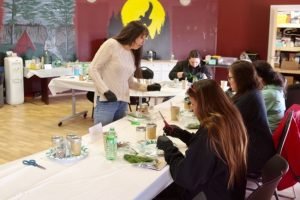
FORT WILLIAM — Fort William First Nation hosted a Wild Medicines Teachings workshop by Couchiching’s Helen Hill on April 25 in the Cultural Room at the Fort William First Nation Community Centre.
“We’re taking two medicinal products and … we’re creating a more medicinal product by combining the two,” Hill says. “Once it’s done, the [product] can either be transformed into a cough syrup by adding some water, they could just use it as a decongestant or a throat soother for children.”
Hill says her goal is to help people regain their health.
“I’m an alternative health practitioner,” Hill says. “I’ve spent probably over seven years in school studying alternative health and just understanding now that our nature is really what provides the medicines that we need to heal, and we’ve slowly been removed from it, and now we slowly need to move back to it.”
Anjali Shah, one of the workshop participants from India, says she enjoyed the workshop and notes that she had been curious to learn more about traditional medicines.
“I was really curious when I just saw this post that it’s about something traditional,” Shah says. “When I was using local transit, I met one gentleman and he told me something about this traditional medicine, so I was really interested, like what kind of things they are using to make this kind of medicine.”
Shah says she spoke with Hill during the workshop and wrote down some of the information she learned from her.
“I think she is a very knowledgeable person, so she gave me all the benefits and everything,” Shah says.
Gail Bannon, culture and mountain coordinator at Fort William, says it is important for people to have some knowledge about the traditional medicines.
“The medicines are out there and they’re with us, we just need to learn how to collect them and bring them together and use them,” Bannon says.
Bannon says she would like to hold at least four traditional medicine workshops per year, depending on Hill’s availability.
“We could have other Knowledge Keepers come in as well and teach different things, to hold one of these maybe once a month,” Bannon says. “It’s valuable knowledge.”
Bannon recalls watching her grandfather gather some roots from the forest to make a traditional medicine for one of her cousins who had a skin problem.
“I remember pulling back moss and he was picking the roots of something,” Bannon says. “He brought it back, dried it up … over a stove, crushed it up and made it into a paste and put it on. I was only about seven-years-old at the time, but I would love to go back in the time and say, ‘Grandpa, what are you picking?’ That’s very valuable knowledge, and with this kind of stuff, we have our stories, we could all come together and learn from each other — maybe somebody knows the name of that root.”
Sarah Bobrowski-Banning, one of the workshop participants from Fort William, says she loved the workshop.
“I would really love to see it continue and I’m excited to see what it turns into and how it progresses,” Bobrowski-Banning says. “I will definitely take this (traditional medicine) home with me and be excited to use it and excited to expand the knowledge. I also like the idea of them doing a Facebook group or a page.”
Bobrowski-Banning says the workshop was very informative, culturally relevant, and inclusive.
“I’m very thankful to Helen for sharing her knowledge and I’m really excited to see where this goes,” Bobrowski-Banning says.