

Anishinabek Nation hosts 4th Annual Diabetes Conference
By Lisa Abel
THE BLUE MOUNTAINS — The Anishinabek Nation hosted its 4th Annual Diabetes Conference, titled Nourishing our Spirits, Nourishing our Bodies—Food, Culture, and Community in Diabetes Care, in The Blue Mountains from April 22-23, where participants heard about the latest advancements in diabetes care, obesity management, and kidney transplantation.
Over the two-day conference, participants explored the experiences of First Nations citizens managing their chronic health conditions, supporting their family members and accessing equitable health care; learned about community practices and resources; and considered Indigenous approaches to nutrition and traditional medicine.
Chippewas of Rama First Nation Elder Stephanie Sandy opened and closed the conference in a good way, expressing thanks for Anishinaabe medicines, prayers, teachings, and strength to be resilient.
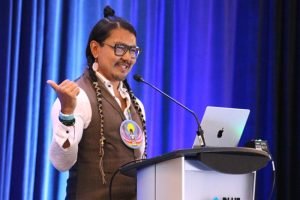
Dr. James Makokis, a Two-Spirit physician from Saddle Lake Cree Nation, stressed the importance of taking part in traditional ceremonies such as Fasting or the Sun Dance to support health and well-being.
“To classify our ceremonies as ‘culture’ does a disservice to it because it’s actually our health system,” Makokis said. “So how do we privilege Indigenous medicines in all aspects of someone’s care, wherever they are?”
Rebuilding Indigenous practices is transformational, Makokis said, and emphasized the importance of investing in traditional medicines, Knowledge Keepers, training, and infrastructure alongside the mainstream health system.
Several presenters shared the importance of supporting food sovereignty and access to traditional foodways that were interrupted by colonialism.
Quinn Meawasige, the Northeast Community Relations Lead for Gaagige Zaagibigaa, shared how this program funds First Nations households in Northern Ontario to reengage in food sovereignty activities like fishing, harvesting, foraging, food processing and preservation, gardening, and even keeping chickens.
“You see grandparents, parents, three generations that are all out there harvesting together,” Meawasige said of the activity reports received. “That’s healing.”
Cody Leeson, Food and Nutrition Program Coordinator at Noojmowin Teg Health Centre, spotlighted how they are supporting food literacy, skills-building towards subsistence harvesting, and access to country foods in Mnidoo Mnising, as well as helping local hospitals offer meals with Indigenous ingredients.
Taylor Murphy, Chronic Disease Management Nurse with the Algonquins of Pikwàkanagàn, shared several health promotion initiatives incorporating healthy eating and sampling different physical activities, such as kicksledding. Their health centre is also developing a chronic kidney disease screening at point-of-care program using telemedicine.
The conference also touched on medical advances in treating diabetes, obesity, and kidney transplantation.
Dr. Rishi Handa, an internal medicine specialist and director of the Durham Care Clinic, Pharmacy and Diabetes Education program, spoke about treating diabetes and obesity together.
“Obesity is a chronic disease. It’s not a character flaw. It needs the same respect as diabetes or hypertension deserves,” Dr. Handa said.
Dr. Handa also stated that Health practitioners should screen for and treat interconnected factors, such as Polycystic Ovary Syndrome (PCOS), obstructive sleep apnea, Metabolic Dysfunction-Associated Steatotic Liver Disease (MASLD), and mental health.
Sharon Sheard, manager of the Regional Renal Program at the Royal Victoria Regional Health Centre in Barrie, stated that Indigenous individuals are significantly less likely to receive kidney transplants compared to Caucasian Canadians and to be placed on a transplant wait list, and more likely to wait longer for a deceased or living kidney donor, and face delays to access pre-transplant assessments due to the distance from transplant centers.
“The entire process has lacked cultural sensitivity and safety,” Sheard said of the inequitable access to kidney transplantation. “It requires a trauma-informed approach, focusing on cultural safety, humility, and the integration of traditional healing, alongside Western medicine.”
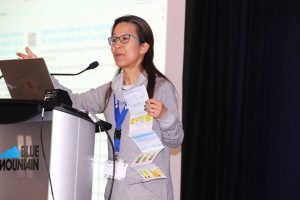
Pharmacist Susie Jin of Diabetes Canada reviewed their updated Quick Reference Guide. She also discussed how continuous glucose monitoring (CGM) is underutilized by those who would benefit from it, while others do not act on their CGM data to reach their targets. Non-Insured Health Benefits covers several CGM systems as a limited-use benefit for clients managing diabetes with insulin, with prior approval required.
The audience heard several compelling presentations from First Nations people sharing lived experiences with diabetes and kidney transplantation.
Shelly Livingston, Director of Health and Social Services for Netmizaaggamig Nishnaabeg, shared how her teenage son was diagnosed with diabetes in 2025, and reflected on how many of their healthcare encounters were not culturally safe.
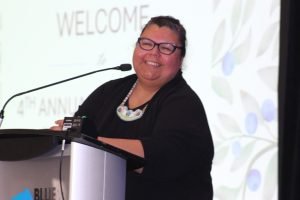
Livingston and a few volunteers started a local Youth Wellness Group to offer a safe space for other youth to understand their own diabetes diagnosis.
Craig Settee, a citizen of Fisher River Cree Nation, screened a short, animated film called “Sacred Gift,” based on the true story of how he chose to become a living kidney donor for his brother Kevin, crediting ceremonies and culture as the foundation to his decision to donate.
Bob Chiblow, former Chief of Mississauga #8 First Nation, shared how he didn’t take the potential long-term consequences of diabetes and neuropathy seriously until a wound in his foot got infected and part of it had to be removed.
“Seeing people struggle with their diabetes was most effective for me…That hits home when you see that,” he said. “So, I like to talk to people, show them my foot. I’m lucky I got to keep [it].”
Conference participants also learned about health inequities and Indigenous self-determination in health.
Internal medicine specialist Dr. David Campbell presented “Low Priority,” a fictional narrative film based on the lived experiences of people with diabetes experiencing homelessness. In a follow-up discussion on patient-centred care, the audience empathized with the film’s scenarios, noting that Indigenous people also face racism and poor care within the healthcare system. Dr. Campbell agreed that reporting mistreatment can give healthcare administrators a better understanding of the frequency and types of negative patient experiences requiring action.
Jennifer Smith, Director of Health System Transformation at the Indigenous Primary Health Care Council, discussed a framework developed by the IPHCC to measure health and well-being in ways that reflect Indigenous worldviews, values and priorities, and emphasize Indigenous self-determination.
“The holistic, strength-based population health indicators take into account culture as care, supportive systems, and healthy, vibrant communities, which also includes emotional, mental, physical, and spiritual well-being.”
Anishinabek Nation Southeast Regional Chief Marsha Smoke attended both days of the conference, and in her concluding remarks, she encouraged community health staff and frontline workers to join the Anishinabek Nation Advisory Committee on Health.
“There’s representation from each of the regions, and it’s very important to have your voices there, in terms of shaping the direction that the Anishinabek Nation needs to work towards [in health],” said Regional Chief Smoke.