

Netmizaaggamig Nishnaabeg Elder shares trapping knowledge with new generation
By Rick Garrick
FORT WILLIAM FIRST NATION — Fort William First Nation’s Social Services, Employment and Training department presented a five-day Trapping Course by Netmizaaggamig Nishnaabeg Elder Stanley Sabourin on April 27-May 1 at the Fort William First Nation Community Centre.
“I have been a trapping instructor for about 30 years, I’ve been a trapper for roughly around 55 years in the province of Ontario,” Elder Sabourin says, noting that he has a trapline about 40 miles long and 25 miles wide near White River. “The course enables you to become a certified trapper on a O1, O2, O3, or O4 trapline, and it’s to reintroduce and get our people qualified and certified to be trappers in the province of Ontario.”
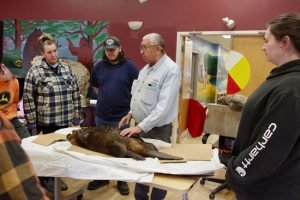
Elder Sabourin says he had a variety of fur-bearing mammals, including three beavers, a coyote, a lynx, a fisher, and some weasels, for the participants to learn the skinning process on the third day of the course.
“Each participant will get an opportunity to get involved in skinning two or three or four of the different mammals that we have here,” Elder Sabourin says. “It’s a one-day session on skinning, and then they have to write a final exam in relation to 50 questions and trap settings.”
Fort William’s Cameron Hardy says the Trapping Course was awesome.
“It’s been a blast learning from Stan — he’s very knowledgeable on the subject,” Hardy says. “I’ve done this a few times, I work with my mentor over at DFC (Dennis Franklin Cromarty High School in Thunder Bay), David Thompson (a Biinjitiwaabik Zaaging Anishinaabek citizen), he’s taught me a lot of this over the years and really got me back into my cultural ways and going hunting and fishing. Now I’m here and I’m going to add trapping to the list of stuff that I want to do.”
Hardy says his plan is to get out on a trapline.
“I’ve seen a few that Fort William posted over the years and I’ve always been interested in getting into trapping,” Hardy says. “I’m glad to be taking this [course], and down the line, my son can join me and start learning this as well firsthand from myself. I’m hoping to keep that knowledge and pass it on, generation to generation.”
Fort William’s Autumn Leger also enjoyed the Trapping Course.
“I think that everyone should have a chance to do this,” Leger says. “For me, the skinning part is pretty easy — it’s the catching part that I might have a hard time with.”
Leger says she would like to be a helper on a trapline in the future.
“I’d like to go with people, I don’t think I’d have my own,” Leger says. “It would be nice to help, it’s good to learn, it’s good to know, but you never know.”
James Forneri, Elder Sabourin’s grandson who helped with the Trapping Course, says everybody participated in the skinning process during the course.
“It’s a required aspect to get your trapping licence, to go hands-on with all the pelts and learn how to skin and set traps,” Forneri says, noting that the participants learned about setting traps on the second day of the course. “Yesterday, we had the 330 Conibear, that’s a big trap for wolves and all that, and we set it off with one of the big skin drawing boards and they felt that, how it snaps back and it’s a lot of pressure.”
Forneri says they appreciated the opportunity to deliver the Trapping Course.
“It’s important for our First Nations people to connect back to the traditional ways,” Forneri says. “We need more of our people doing that.”