

‘Trafficking is everybody’s issue,’ says Ontario Native Women’s Association Indigenous anti-human trafficking development coordinator
By Rick Garrick
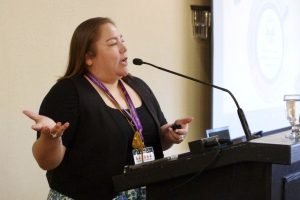
THUNDER BAY — Beausoleil First Nation’s Diane Marion shared her Healing from Human Trafficking presentation at the Aboriginal Shelters of Ontario’s Anti-Human Trafficking Conference on May 1 in Thunder Bay. The conference, which was held at the Best Western Plus Nor’Wester Hotel and Conference Centre, also included presentations by the Ontario Native Women’s Association’s (ONWA) Hannah Buck and Lindsey Lickers and Thunder Bay Police Service’s Detective Constable Amanda Zappitelli and Detective Constable Jason Nistico.
“When I quit the alcohol is when I started trying to learn my culture, and that was probably the hardest because I never went to my own community, I’d never been there other than I think when I was little a few times,” Marion says. “The biggest thing that helped me was when I went back home because everyone was really loving and inviting. But I still struggled because I didn’t know who I was and I didn’t know my clans. When it came to healing, that was actually the biggest thing for me, it was the biggest game changer because I met people that knew my grandma, knew my family.”
Marion says the reason she speaks about human trafficking is that she doesn’t want anyone to go through what she went through.
“I don’t want anyone to go through that alone again,” Marion says. “Like, to go through that by yourself, I’d never wish that on anyone because the stuff that I fought through, I don’t even know how I made it.”
Lickers, Indigenous anti-human trafficking development coordinator at ONWA, says she has been doing anti-human trafficking work for about 12 years, noting that she recently exited a person from human trafficking about two weeks before the conference.
“One thing that I started to notice from doing this work for so long, and again taking a step back and starting to do some of the research pieces, some of the policy advising, the advocacy and kind of building capacity in this space for probably (seven) years now … was the Indigenous experience of trafficking is unique,” Lickers says. “Now are there markers that are very common? Yes, 100 per cent from mainstream into our communities, because trafficking is everybody’s issue, it’s everybody’s issue from us frontline workers, from Indigenous community to police, yes, lawmakers, but even banks, even hospitality, transportation, it literally encompasses everything. So that’s what I’m really kind of putting forward when I do these trainings is that trafficking is everybody’s issue and you should be doing something about it regardless of what position you have.”
Zappitelli says their number on priority is building rapport with human trafficking survivors.
“The survivor almost never wants to give us a rapport at first,” Zappitelli says. “We do a lot of meeting them, chatting with them, basically letting them know that we’re not some cop in a uniform that just wants to get in and get out. We understand that this was an entire lived experience where their every move was determined for them, so we’re not going to do that — it takes a long time.”
Nistico says most of the people involved in human trafficking are not going to trust the police right away.
“The barriers and the hurdles are there right from the very beginning with us, so we have to try to overcome that right away, and the success rate is very low,” Nistico says.
“Right now, we’re just trying to focus on getting people out of [human trafficking] — if we can get somebody out of [human trafficking] and into treatment or on a path to a better life, then we consider that a win.”
Ashley Doxtator, training coordinator at Aboriginal Shelters of Ontario, says they will be holding another Anti-Human Trafficking Conference for people in southern Ontario in mid-September in Ottawa.
“The idea of this is just to provide awareness and education to our frontline workers, and then we opened it up to community so we have ONWA here, we’ve shared it with the Friendship Centre and just local community members,” Doxtator says.