

Panelists discuss data sovereignty at Toronto conference
By Sam Laskaris
TORONTO – Rylee Restoule is getting busier and busier.
Restoule, a member of Dokis First Nation, is the clinical research coordinator of Indigenous health at the Sudbury-based Health Sciences North Research Institute (HSNRI).
Restoule was also recently in Toronto attending the Chiefs of Ontario Powering Up Data Sovereignty conference. The three-day event concluded on May 14.
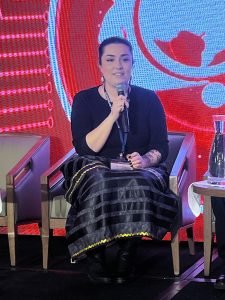
Restoule was a panellist for an opening-day session titled Approaches to Implementation: Regional Overviews and Perspectives on First Nations Data Sovereignty.
“We have increasing requests from education and healthcare and other organizations for research,” she said. “And obviously, when communities don’t have these works in place, they’re left in a really vulnerable position.”
Another speaker on the panel was Geoff Stonefish, a Delaware Nation member who is the director of operations for the Association of Iroquois and Allied Indians (AIAI).
Restoule said a key Anishinabek Nation initiative is the development of a relationship protocol with the HSNRI.
“This is a resolution that has been passed at the most recent Grand Council Assembly in the fall,” she said. “The resolution entails a partnership with the Health Sciences North Research Institute to develop a relationship protocol. And then within that protocol, develop research and data governance frameworks for our communities.”
Restoule said some challenges related to capacity have arisen.
“Our leadership, our staff and communities are dealing with other pressing issues,” she said. “They’re realizing things happen in community that require people’s attention. Data governance and research is not necessarily a pressing priority when there are other things going on.”
Restoule also said another challenge has resulted because of geographical areas.
“When things are really far apart physically, communication can get difficult on those topics,” she said.
Anishinabek Nation, which supports 39 First Nations, is spread throughout the province.
“Although we are all Anishinaabe communities, there are different worldviews and teachings that live within that region,” she said, adding that at times, it is important to prioritize regional representation in certain work that is done.
Restoule also said there is an increasing interest in data governance work. And officials are learning plenty of lessons along the journey.
For example, the need to support those students and others doing data governance work. Restoule also said there is a need to partner with organizations that have the power to further this work.
And she also said organizations need to be mindful of where exactly they are working.
“You need to make sure that people are represented the way that they want to be represented,” she said.
As for Stonefish, he’s been working for the AIAl for about 25 years. He’s held various other roles, including health policy advisor and social services policy advisor.
“Our first serious look at data collection started in the late 1990s,” he said. “I think that was with a regional health survey. It gave us an idea of what data collection looked like and the importance of it.”
Stonefish said an early initiative consisted of gathering current health and social data from communities.
“Our Chiefs at the time realized that data and information painted a picture for things,” he said. “It told a story about our communities. And they realized the importance of that data, that information. And that’s what we wanted to do. They wanted to tell our community story.”
Stonefish said that prior to AIAI’s dive into its own data collection, it relied on data supplied by governments. But that information, at times, was difficult to obtain.
“So, data sovereignty, ownership of that, was really important to us,” he said. “That’s why we started on the road, trying to implement these projects with data collection.”
Stonefish said other AIAI projects looked at over the years include ones collecting housing data.
Initiatives included obtaining the numbers of new units and renovations.
“Those help our leadership advocate for communities,” he said. “That’s our role – to advocate in communities. So, that’s how we design our projects on data collection.”
Stonefish said AIAI also collected data on economic development.
“Our most recent project that we’re working on is an education dashboard,” he added. “And that is to collect education information, really similar to the work that the Chiefs of Ontario is doing on their education dashboard.”
Stonefish also said one of the challenges faced over the years in collecting data is distrust, partly because data and information have been used against Indigenous people in the past.
“That’s one of the biggest areas that we’ve experienced is that lack of trust, not just with government collecting information, but also the process of organizations collecting information,” he said. “There’s distrust there.”