

Whitefish River members provide details of Manitoulin Island committee at Toronto conference
By Sam Laskaris
TORONTO – A few decades ago, it was common for researchers to visit various First Nations on Manitoulin Island, take information and leave, never reporting back to the communities about their findings.
That’s why various First Nations officials decided it was imperative to develop a research ethics committee.
The Manitoulin Anishinaabek Research Review Committee (MARRC) was created following a conference in March of 2001.
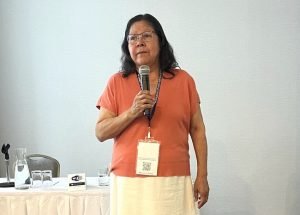
A pair of Whitefish River First Nation members – Dr. Lorrilee McGregor and Dr. Susan Manitowabi – provided details about MARRC at the Chiefs of Ontario Powering Up Data Sovereignty conference.
The three-day event, which wrapped up May 14, was staged at the Chelsea Hotel in Toronto.
Dr. Manitowabi and Dr. McGregor spoke at an opening-day conference workshop session titled Research Ethics on Mnidoo-Minsing.
During the presentation, Dr. McGregor provided some evidence why MARRC was greatly needed.
Several decades ago, she said an anthropologist from the University of Michigan was exploring Manitoulin Island, looking for evidence of trade routes. During the visit, he was led to a burial site.
“He excavated human remains,” Dr. McGregor said. “He packed them in boxes. And he shipped them off to the University of Michigan in Ann Arbor. At that time, I guess it was pretty easy to cross the border with things like human remains. And so, our ancestors were held at the university for decades.”
Dr. McGregor said that in the 1980s, a community member visited Ann Arbor with another researcher when someone mentioned there were human remains in the anthropology department.
“It was like decades of fighting against the University of Michigan to, I would say, rematriate those ancestral remains,” Dr. McGregor said. “The first thing that the university did was deny that they were our ancestors.”
Later on, school officials were willing to return the remains, but they wanted to extract teeth from skulls to obtain DNA materials.
“Essentially, they were holding our ancestors hostage,” Dr. McGregor said.
Dr. McGregor also talked about a couple of other less-than-satisfactory research efforts in First Nations on Manitoulin Island.
One was created by a Toronto-based physician/researcher who went to the communities to conduct rheumatoid arthritis research. Though he had Band Council permission, he took samples from members, but he wasn’t heard from again.
That is, until some sleuthing when the researcher was located. He came back to present his results, but the forum he chose to do so was at a local bingo night.
Dr. McGregor said a graduate student also showed up on Manitoulin Island in the 1990s to do a study on the Indian Residential Schools.
“The Chiefs basically told this researcher to leave the communities, that she wasn’t welcome there to do her research,” Dr. McGregor said. “She hadn’t got community consent. She had no involvement with the communities. There was no supports for people who would be telling their probably very traumatic stories of being in Residential Schools.”
Dr. McGregor said other projects were also undertaken.
“There’s plenty more stories of terrible research that has gone on in Manitoulin Island,” she said. “And so, finally, we said we had enough.”
That’s when MARRC was launched.
“We developed a strategic plan that would encourage research on topics that were relevant for the planning of local services,” Dr. Manitowabi said. “And we developed a guideline; it was called Guidelines for Ethical Aboriginal Research. And that guideline was used as a screening tool to help communities decide if a research project was ethical.”
Dr. Manitowabi said it didn’t take MARRC officials long to pick up on a fact.
“One of the things we learned early on is that communities need research and they need researchers,” she said. “But they also want researchers to be there for the long haul. So, if you did really good research with the community, then they’d say, ‘Here’s another project that we want you to work on.’ And we built that relationship with them.”
Dr. Manitowabi said MARRC representatives are doing their best to assist those who are doing valuable work.
“What we try to do is to be responsive to community positions on research and data sovereignty,” she said.
Dr. Manitowabi also said there has been a shift now to the development of biological sampling guidelines. Previously, MARRC focused on health research.
Dr. Manitowabi also said MARRC officials have discovered that research and data collection programs take time to evolve.
“We need commitment and support from First Nations communities and committee members,” she said. “We need the support from our stakeholders. The process benefits from community champions. And there’s a lot of them in our MARRC committee. We need to keep communities involved and engage as many community experts as possible.”