

Industry partners stress importance of partnerships with First Nations at Toronto forum
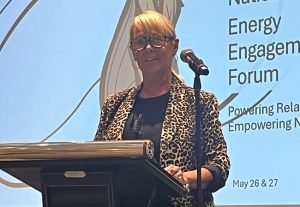
By Sam Laskaris
TORONTO – As energy demands soar in the province, First Nations are playing an increasingly bigger role in the sector.
At the recent Anishinabek Nation Energy Engagement Forum, various industry partners were invited to make presentations not only about the roles they play in the sector but also how they are working alongside various Indigenous communities.
The forum, which ran May 26-27, was held in Toronto.
“At its core, electricity is about people,” said Carla Nell, the executive vice-president of corporate relations, engagement & strategy for the Independent Electricity System Operator (IESO). “It’s about connecting homes and businesses across the province to the grid and the economic and social well-being that provides. But also, very importantly, it’s also increasingly about communities and First Nations leading the development that is happening on their lands as it relates to Ontario’s electricity grid.”
The IESO is a Crown corporation that is responsible for operating the electricity market in Ontario.
An IESO goal is to boost future energy growth. Nell realizes how that will be accomplished.
“We have to build positive, inclusive, and enduring relationships with First Nations, including Anishinabek Nation members,” she said. “It is absolutely critical to our work. It is foundational to our success in securing our shared energy future for generations to come.”
Nell also said as electricity demands are growing, First Nations are asking questions on how will development affect their lands, how can communities benefit and be involved, and how can they be involved not at the end, but from the beginning.
“When we look at how far we’ve come in a few short years by focusing on partnerships, and building relationships and engaging meaningfully with one another, that has been the momentum behind an important shift from planning and participation to increasingly and consistently First Nations’ ownership,” Nell said. “It’s happening throughout the sector.”
Nell also said continued teamwork is required.
“We know that reconciliation is not a one-time effort,” she said. “It is an ongoing commitment that requires deep dialogue. And that can only be achieved through the long-term relationships that have been reinforced as being so important.”
Nell also said it’s no secret Ontario will require more electricity in the coming years.
“A lot more, based on all of our latest forecasts,” she said. “And we acknowledge that much of that infrastructure is going to need to be built on or near Anishinabek lands. And so that creates a responsibility. And it also creates opportunities, but only if it’s done right.”
Amy Gibson, the manager of the Indigenous Energy Policy for the provincial Ministry of Energy and Mines, said Ontario is entering one of its largest periods of energy system build-out in decades and that there will be major changes in the next 30-50 years to deal with that.
“This looks like new transmission to support growing communities and industries, new generation and storage to meet rising electricity demand, expanded opportunities for Indigenous equity participation and a stronger focus on community-driven energy planning,” Gibson said.
This requires First Nations partnerships at every stage, she added.
“For us in the ministry, that means engagement and consultation begins early, before decisions are made,” she said.
This ensures communities have the information, time, and capacity needed to participate meaningfully and that concerns and priorities shape the direction of projects and policies.
“First Nations must be at the table as rights-holders, treaty partners, and economic development partners,” Gibson said. “Every policy we shape, the projects we get, and decisions we make must be grounded and respect First Nations rights, meaningful consultation, and real partnership.”
Matthew Jackson, Hydro One’s vice-president of Indigenous partnerships and business development, was another industry representative who spoke at the forum.
“We acknowledge regularly that there is no path of decarbonizing Ontario’s grid or building the future without crossing First Nation government territories,” he said. “And this requires a deep and continual approach, partnership that’s progressive.”
Jackson said Hydro One is committed to having strong ties with First Nations partners.
“We recognize that access to reliable power is even more critical in First Nation communities as we see an increase in an influx in development, new housing, and infrastructure,” he said. “And we’re focused on advancing new investments to make sure that we enable this growth as a strong partner.”
Jackson added that officials with his company are not simply partnering with First Nations to make themselves look good.
“For us at Hydro One, Indigenous partnerships are not about a checkbox,” he said. “We’re about embracing Indigenous leadership and fostering early collaboration on project development, decision-making, [and] how we plan and operate.”
Jackson also realizes that Hydro One representatives are not perfect in their dealings with First Nations.
“I often say we haven’t got everything right,” he said. “But we are laser-focused on trying our best and pivoting fast when we don’t get it right.”
David Walders, the Indigenous relations manager at the Ontario Energy Board (OEB), also made a presentation at the forum. The OEB is the independent regulator of Ontario’s electricity and natural gas sectors.
“A key feature of the OEB in our work is that it happens through transparent public hearings, where evidence is filed, tested, and carefully considered,” he said. “These hearings are open to participation from intervenors, including First Nations. First Nations can and do participate in the OEB’s regulatory processes.”
Walders explained why these collaborations are vital.
“This participation is extremely important because it brings forward perspectives grounded in lived experience, Indigenous knowledge, and community priorities,” he said.
Walders also detailed some other work the OEB is undertaking, including with First Nations.
“We’re really trying to be more proactive about our external engagement,” he said. “And this involves us getting out of the office and going to communities. This kind of engagement, being present, listening carefully, and building understanding is an important part of how we’re trying to do things differently.”