
Anishinabek Nation Language Commissioner receives Algoma University Honorary Doctor of Fine Arts degree
By Rick Garrick
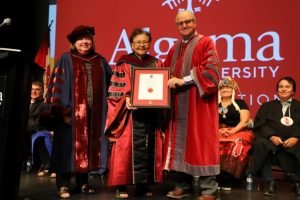
SAULT STE. MARIE — Anishinabek Nation Language Commissioner Barbara Nolan was conferred with an Honorary Doctor of Fine Arts degree during Algoma University’s Spring convocation ceremony on June 13 at the Sault Ste. Marie Community Centre in Sault Ste. Marie, Ontario.
Commissioner Nolan, who is originally from Wiikwemkoong Unceded Territory and now lives in Garden River First Nation, began her acceptance speech with comments in Anishinaabemowin before continuing in English.
“Boozhoo, Aanii, Sago, Waachey kina ndinwendaagnag,” Commissioner Nolan says during the afternoon convocation ceremony. “Waabigankwe ndigoo, makwa ndoodem, Wiiwemkoong ngii-bi-nibaanaaba, Gtigaan Ziibiing nongwa ndidaa. Aapji go nigichi-nmaamiikwendam maanda ezhi-mnaajigo’aanh nongwa, gaa go gnigenh gegoo ngii-dinendziin maanda wiikaa ji-zhiwebag. Miigwech ndi-naag kina gwaya gaa-nagmi’aad wii-debnamaanh maanda mingwewziwin. Nmiigwechwi’aag ge’e Algoma University Ogimaag.”
Commissioner Nolan reflects on when she first found out during her remarks.
“Greetings all my relations, I was overwhelmed when I received the letter. It says, ‘Dear Dr. Barbara Ann Nolan,’ and I thought, who is playing a trick? I thought one of my friends was doing that, but I read on, and I was just overwhelmed with receiving that news.”
Commissioner Nolan was recognized for her lifelong dedication to preserving and teaching Anishinaabemowin. A respected language educator, curriculum developer, immersion instructor, and counsellor, Commissioner Nolan has spent decades advancing Indigenous language learning through accessible educational resources, community leadership, and vital student support. Her innovative work has fundamentally influenced language education initiatives, not only across Canada but also internationally. Through rigorous research and compassionate advocacy, her efforts have profoundly supported both Indigenous learners and Indian Residential School Survivors and their families, ensuring that the vibrancy of the Anishinaabe language continues to thrive for generations to come.
“Never did I ever think I would receive such a high award,” Commissioner Nolan says. “I thank those who nominated me, those who voted for me to select me to receive this award. I say thank you to Algoma University leadership.”
Commissioner Nolan says her late father truly believed in education.
“He said, ‘If you are to be successful in this new culture, you have to be educated,’” she says. “You may have to leave the reserve and go and work in other places to become a doctor, a nurse, to become a teacher, to become a lawyer. Whatever you want to be, you have to get that education.”
Commissioner Nolan says she was first taken to Spanish Indian Residential School, where she had to learn a new language, English.
“I did not even know thank you or hello,” Commissioner Nolan says. “I was just fluent in Anishnaabemowin at the age of five, I didn’t know anything else. Our dad believed that you must learn the new settler’s language to be successful in the outside world. We had to speak that language, we had to learn to write that language, we had to learn to read, write everything, we had to learn all that.”
Commissioner Nolan says she was taken to Indian Residential School for four years before she began attending school in her community. She developed the region’s first elementary school Anishnaabemowin curriculum in 1973, the success of which prompted Algoma University and Sault College to request her expertise in establishing their own foundational language courses.
“Every change that I made in my life, language was pulling me,” she says.
She thought for a long time about making videos to teach Anishnaabemowin to people who are located hundreds of miles away.
“These videos are on YouTube, kids’ videos, as well as videos that are not animated,” Commissioner Nolan says. “These videos will live on for years, as they are on YouTube and available free of charge. These videos have become a hit, especially with children and teachers because children love the videos. And the teachers are so happy to have that resource and they utilize it in their classes.”
Commissioner Nolan’s videos can be found online.
She was appointed as the Anishinabek Nation Language Commissioner in 2020, and she was also the recipient of the 2021 Ontario Arts Council Indigenous Arts Award.